
Bulk Bag, FIBC, Tote, Super Sack — A Terminology Guide
FIBC, bulk bag, 1-ton tote, jumbo bag, big bag and Super Sack usually describe the same object: a woven polypropylene container that holds roughly a tonne of dry material and lifts on four loops. The words are not quite interchangeable, though, and the places they diverge are the places purchase orders go wrong.

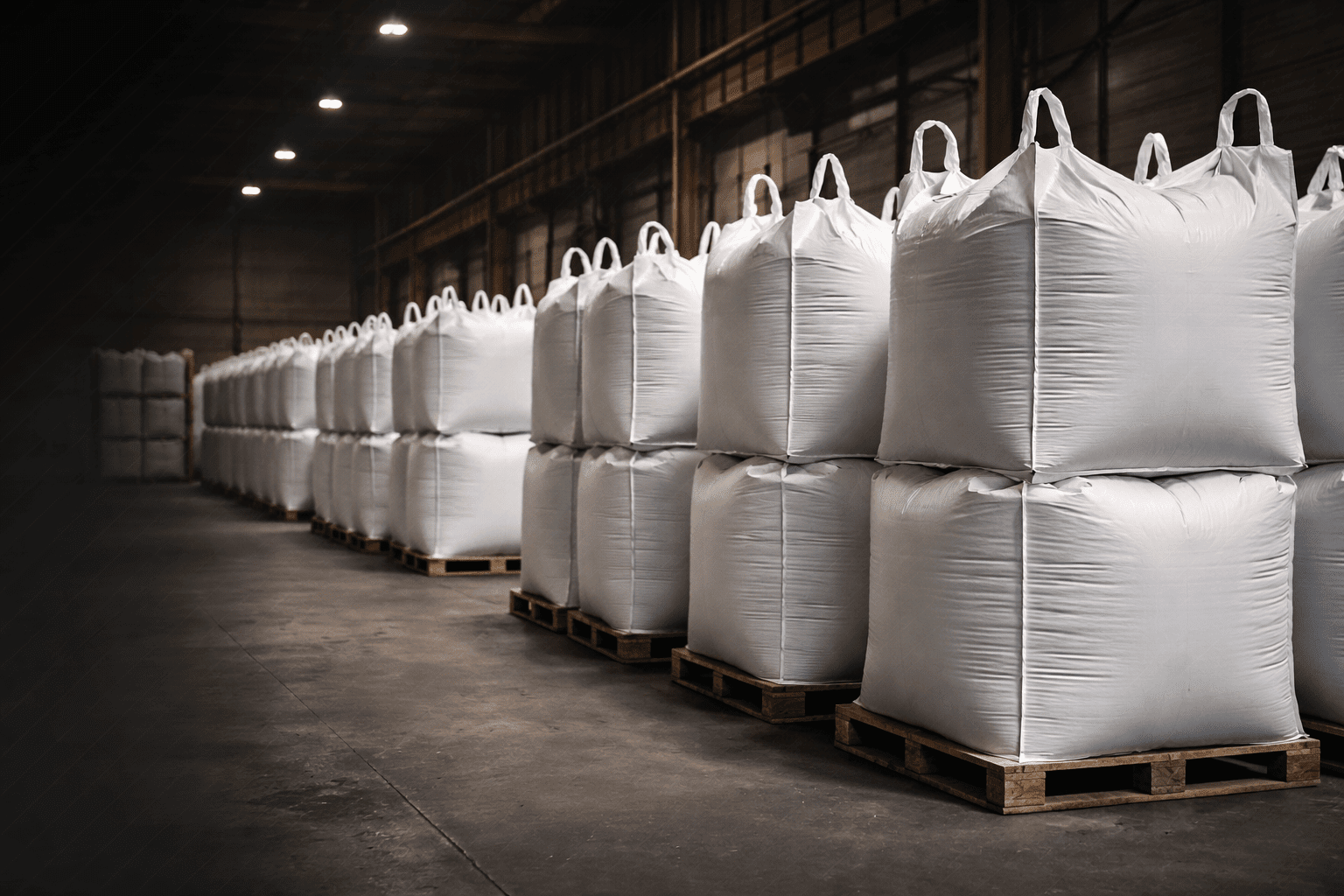
FIBC, bulk bag, 1-ton tote, jumbo bag, big bag and Super Sack usually describe the same object: a woven polypropylene container that holds roughly a tonne of dry material and lifts on four loops. The words are not quite interchangeable, though, and the places they diverge are the places purchase orders go wrong.
This is a short guide to the vocabulary, written for buyers who have inherited someone else's spec sheet and want to know whether the words on it mean anything.
The terms, ranked by how precise they are
| Term | Where it comes from | Precision |
|---|---|---|
| FIBC | Flexible Intermediate Bulk Container — the term used in ISO standards and regulatory text | High. Use this in specifications. |
| Bulk bag | Common North American trade term | High in practice. Everyone in the industry knows what you mean. |
| Big bag | Standard usage across Europe | High, but reads as an import term in Canada. |
| Jumbo bag | Common in Asian manufacturing | Moderate. Widely understood, occasionally used for smaller sacks too. |
| Ton bag / 1-ton tote | Trade shorthand describing capacity | Moderate. Describes a load rating, not a size. |
| Tote | Generic handling term | Low. Also means a rigid plastic container. Ambiguous on its own. |
| Super Sack | A registered trademark of B.A.G. Corp | Not a category. A brand name used generically. |
Two terms worth handling carefully
"Super Sack" is a trademark
Super Sack is a registered trademark belonging to B.A.G. Corp, in the same way that Kleenex belongs to Kimberly-Clark. It has drifted into generic use across the industry, and when a buyer asks for "super sacks" everyone understands they mean FIBCs. But it is a brand, and it does not describe a specification.
If it appears on an inherited spec sheet, treat it as meaning "FIBC" and then go find the actual dimensions and load rating, because the word itself tells you nothing about either.
"Tote" means two different products
This is the one that causes real confusion. In bulk material handling, tote is used for both:
- A woven polypropylene FIBC — "we ship it in one-ton totes"
- A rigid plastic or composite container, often an IBC with a cage and a valve — "send me a 1,000 litre tote"
Those are entirely different purchases with different price points, different handling equipment, and different cleaning regimes. If you write tote on a PO without a material and a dimension, you have a reasonable chance of receiving the wrong category of product.
The fix is simple: say "woven bulk bag" or "FIBC" when you mean fabric, and "rigid IBC" when you mean a caged container.
Why a "1-ton bag" often will not hold a tonne
This is the most expensive misunderstanding in the category, and it has nothing to do with vocabulary and everything to do with density.
A "1-ton bag" is rated to a safe working load of 1,000 kg (2,205 lb). That is a structural rating. It says nothing about whether your material will physically fit.
Take a common standard size — 90 × 90 × 110 cm (35 × 35 × 43 in). That is roughly 0.89 m³ of usable volume. What it holds depends entirely on bulk density:
| Material | Approx. bulk density | Mass in a 0.89 m³ bag | Limited by |
|---|---|---|---|
| Cement powder | ~1,400 kg/m³ | ~1,250 kg | Safe working load |
| Wheat | ~770 kg/m³ | ~690 kg | Volume |
| Wood pellets | ~650 kg/m³ | ~580 kg | Volume |
| Wood shavings | ~150 kg/m³ | ~130 kg | Volume, heavily |
Bulk densities vary with moisture, particle size, and how the material settles, so treat these as illustrative rather than as design figures for your own product.
The pattern still holds regardless. For dense powders you hit the load rating first and a taller bag buys you nothing. For light materials you run out of space at half the rated load, and the correct move is a larger bag, not a stronger one. Buyers who order "1-ton bags" for wood shavings and then discover they are shipping 130 kg per bag have bought the wrong size, not the wrong bag.
The practical question to ask before specifying a dimension: what is my material's bulk density, and does volume or weight run out first?
What actually belongs on the purchase order
Once these four things are stated, the nickname genuinely does not matter. Call it whatever your operation calls it.
- Dimensions — width × depth × height, in both metric and imperial if you work across the border
- Safe working load — in kg, with the safety factor stated separately (5:1 for single trip, 6:1 for multi-trip)
- Fill and discharge configuration — duffle top, spout top or open top; flat bottom or discharge spout
- Fabric and liner — fabric weight in GSM, plus liner type and thickness if you need one
Anything beyond that is a specialisation worth naming explicitly: baffle bags to hold a square shape, conductive Type C or Type D for combustible dusts, ventilated bags for produce, food-grade for edible product, UN-rated for dangerous goods.
A note on "breathable" and "ventilated"
One more pair that gets used loosely. Ventilated FIBCs have deliberate mesh panels woven into the sidewalls for airflow — they exist for potatoes, onions, firewood and similar produce. Breathable is often used to describe uncoated woven fabric generally, which does allow some moisture vapour transfer but is not the same thing as a mesh panel.
If your material needs airflow, ask for ventilated and confirm the panel configuration. If it simply must not sweat, uncoated woven fabric without a liner is usually the answer.
Where to go from here
Sackora supplies ISO 21898 tested FIBC bulk bags across Canada and the United States from our Richmond Hill, Ontario warehouse. Standard duffle-top configurations sit at FIBC bulk bags, with baffle, conductive, ventilated and food-grade configurations engineered to specification.
If you have an inherited spec sheet with vocabulary on it that nobody at your company can source from any more, send it over. Working out what a previous buyer actually ordered is a routine part of what we do.