
How to Spec FIBC Fabric Weight
Most FIBC procurement decisions get stuck on dimensions and SWL. Fabric weight quietly drives cost, drop performance, and the difference between a single-trip bag and one your operator can re-stage three times.

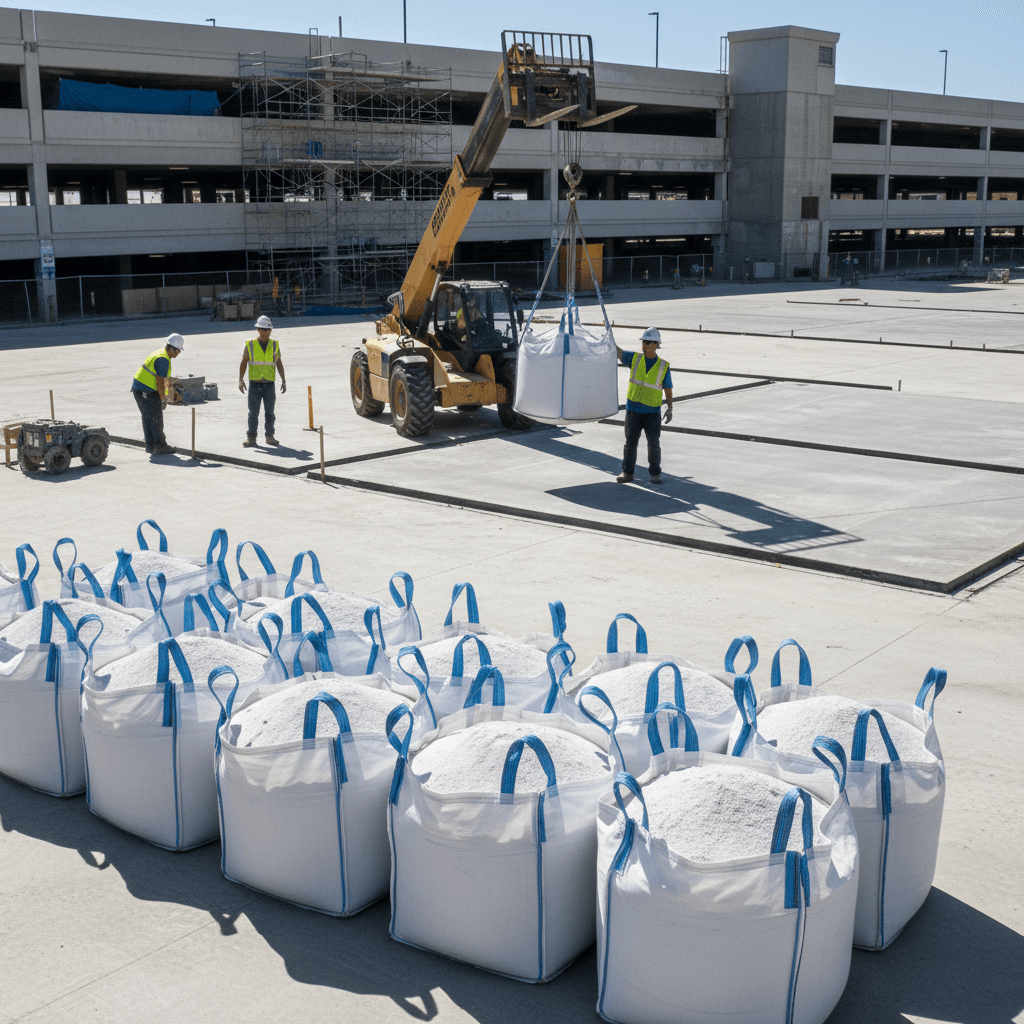
Walk into any FIBC procurement conversation and you'll hear a lot about safe working load and dimensions. You'll hear far less about GSM — fabric weight in grams per square metre — even though it's the single spec that quietly drives cost, durability, and whether the bag survives the third lift. This is a guide for the buyer who has to defend a fabric-weight choice on a 5,000-bag PO and doesn't want to overspec or end up with claims.
What GSM actually measures
GSM is the weight per unit area of the woven polypropylene fabric. It's a proxy for tape thickness, weave density, and ultimately tensile strength. A 160 GSM tubular fabric and a 230 GSM tubular fabric are made on the same loom but with thicker tapes, higher tape count, or both. The heavier fabric resists tearing, abrasion, and UV breakdown longer.
For 1,000 kg SWL FIBC bags, the practical industry range is 150 to 230 GSM. Anything lighter than 150 GSM struggles to pass ISO 21898 drop testing at a 5:1 safety factor. Anything heavier than 230 GSM is over-engineered for almost every use case outside of multi-trip mining or chemical operations with aggressive abrasive loads.
When to overspec, when to underspec
Three questions decide where you should land on the GSM scale:
- How many trips will the bag make? Single-trip export shipments — bag is filled, shipped, emptied, discarded — perform fine at 150–170 GSM. Multi-trip bags (3+ uses) need 180+ GSM to maintain structural integrity through repeated handling.
- Where will the bag spend its dwell time? Indoor warehouse storage is gentle. Outdoor storage at construction sites, mine yards, or grain elevators exposes the fabric to UV degradation, freeze-thaw cycles, and forklift abrasion. Outdoor dwell pushes you to 180+ GSM and a higher UV package.
- What's being loaded? Smooth flowing materials (sugar, flour, plastic pellets) are easy on fabric. Aggregates, demolition debris, and angular minerals (silica sand, crushed stone) abrade and puncture. Aggressive loads need 200+ GSM minimum.
The cost math
Moving from 160 GSM to 200 GSM on a standard 90 × 90 × 110 cm duffle-top FIBC adds roughly 8–14% to per-bag cost at container volumes — the higher end if you're also bumping the safety factor or adding a PE liner. On a 5,000-bag PO at $9.50 per bag, you're looking at $3,800–$6,650 in additional spend for the upgrade. That math is easy to defend if it prevents one damaged-load claim. It's hard to defend if your bags are emptied and discarded after one use.
What GSM doesn't fix
Fabric weight is necessary but not sufficient for several common FIBC procurement problems. Drop performance is enforced by ISO 21898 drop testing, which considers the weave, seam strength, lifting loop attachment, and bottom panel construction — not GSM in isolation. UV resistance comes from the HALS (Hindered Amine Light Stabilizer) additive package compounded into the resin during extrusion; you can have a heavy 200 GSM fabric with a poor UV package that fails after 3 months outdoors. Static dissipation (Type C, Type D) is a fabric construction choice, not a weight choice.
If you're sourcing for a flammable powder application, the conductive spec dominates GSM. If you're sourcing for food contact, the food-grade requirement (FSSC 22000 facility, virgin PP resin) dominates GSM. Solve those constraints first, then pick weight.
Reading the spec sheet
Mill spec sheets vary in honesty. The benchmarks to verify:
- Fabric weight in GSM — should match what you ordered. Mill tolerance is typically ±5%; reject anything outside ±8%.
- Tensile strength in N/5cm (warp and weft). Should be ≥600 N/5cm warp for 150 GSM, scaling proportionally upward.
- UV stabilization rating — disclosed as either active HALS percentage (0.2% to 2.5%) or as accelerated weathering hours per ASTM G155 or G154. See our guide to UV ratings for the conversion math.
- ISO 21898 test report — drop, top-lift, tear-propagation, cyclic-use. The certificate should reference your specific construction.
Where to push back with your supplier
If a supplier offers you a price that's 15%+ below other quotes for the same nominal GSM and SWL, ask to see the mill's tensile test data. Underweight fabric (e.g., a 145 GSM bag sold as 160 GSM) is a known cost-cutting trick in some Asian mills. The drop test will pass for fresh bags; the failure shows up in months 2–6 of outdoor storage when UV degradation compounds with the underweight fabric.
The right fabric weight is the one that matches your trip count, dwell environment, and load aggressiveness — not the lowest GSM that passes the drop test on day one.