
How to Evaluate an FIBC Supplier in Canada
An FIBC bulk bag is a flexible intermediate bulk container woven from polypropylene, built to carry between 500 and 2,000 kg of dry bulk material. Buying one is simple. Buying ten thousand from a supplier who can prove what they sold you is where Canadian procurement gets interesting.

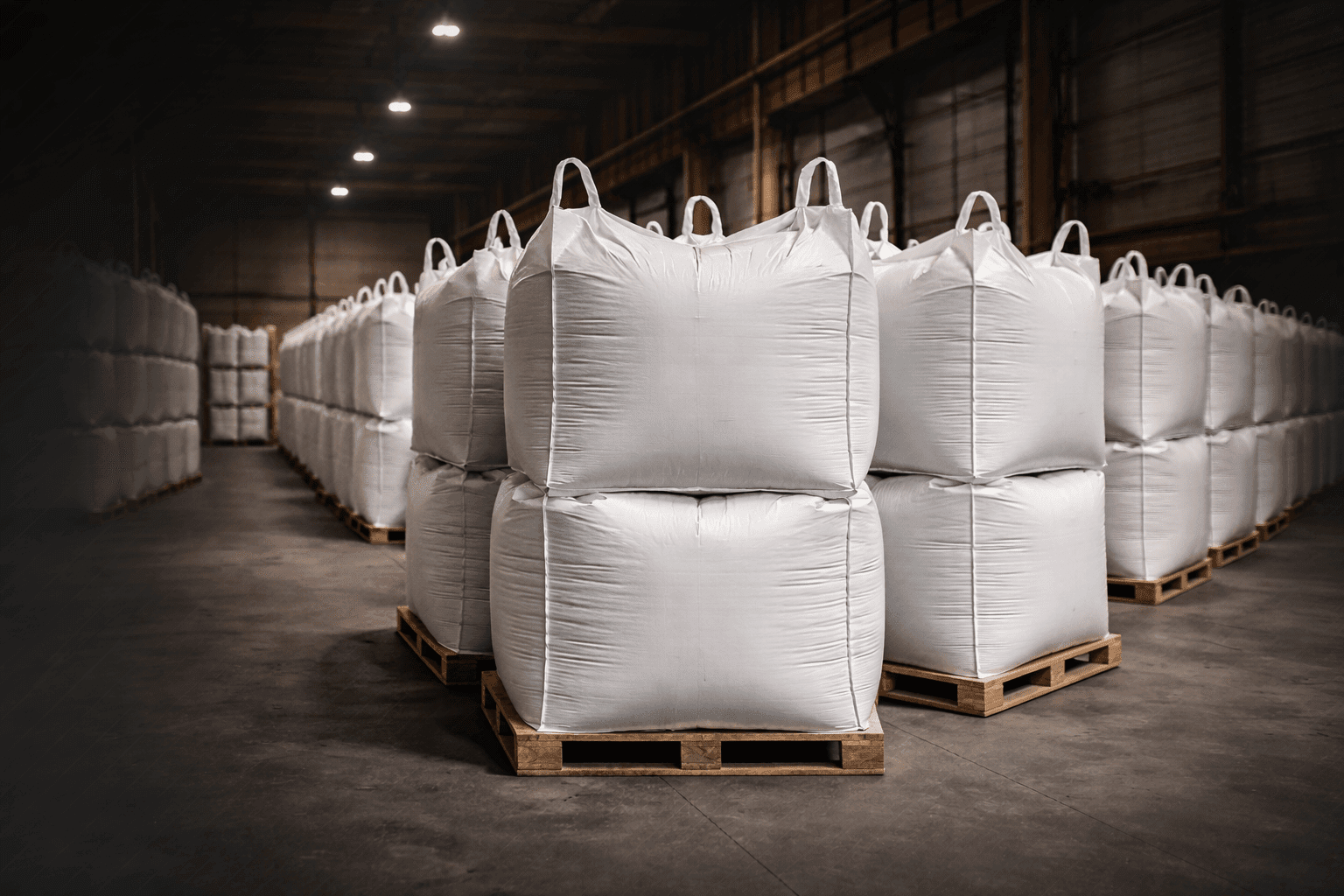
An FIBC bulk bag is a flexible intermediate bulk container woven from polypropylene, built to carry between 500 and 2,000 kg of dry bulk material. Buying one is simple. Buying ten thousand from a supplier who can prove what they sold you is where Canadian procurement gets interesting.
Most FIBC quotes that cross a Canadian buyer's desk look identical: a dimension, a safe working load, a price per bag. The differences that matter — the ones that show up as a split seam on a loading dock or a rejected food-contact audit — sit in the documentation behind the quote. This guide covers what to ask for and how to read the answers.
ISO 21898 is a test standard, not a badge
This is the single most common misreading in FIBC procurement. ISO 21898 — Packaging: Flexible intermediate bulk containers (FIBCs) for non-dangerous goods — specifies how a bag is tested. It is not a certification that a company holds in the way a facility holds FSSC 22000.
So when a supplier says they are "ISO 21898 certified," the useful follow-up is: show me the test report for the configuration I am buying. A test report on a 90 × 90 × 110 cm duffle-top flat-bottom bag tells you nothing about the spout-bottom bag you actually ordered.
The standard covers four test families worth knowing by name:
- Top lift — the bag is loaded to a multiple of its SWL and lifted by its loops
- Drop — a filled bag is dropped from a specified height onto a rigid surface
- Tear propagation — a deliberate cut is made in the fabric and the bag is loaded to see whether the tear runs
- Cyclic (topple) testing — repeated lifts, relevant for any bag rated for multiple trips
Tear propagation is the one procurement teams skip and operations teams care about most. A bag that passes top lift but runs a tear from a forklift nick is the bag that fails in your yard, not in a lab.
Safety factor: 5:1 and 6:1 are different products
Safety factor is the ratio between the load a bag is tested to carry and its rated safe working load. It is the clearest single indicator of what you are buying.
| Safety factor | Intended service | What it means in practice |
|---|---|---|
| 5:1 | Single trip | The industry norm for dry bulk. Bag is filled, shipped, discharged, and retired. Most aggregate, mineral, and agricultural volume moves this way. |
| 6:1 | Multiple trips | Heavier fabric, reinforced seams, cyclic testing. Costs more per bag and is genuinely necessary only if bags return to you for refilling. |
| 8:1 | Specialised | Rare outside specific dangerous-goods and lifting applications. |
The procurement trap runs in both directions. Buying 6:1 for single-trip service is money spent on fabric you throw away. Buying 5:1 and then refilling bags because they look fine is a safety problem, not a cost saving — a bag that has been loaded, discharged, and stored outdoors has a fatigue history nobody has measured.
If bags come back to you, say so at quote stage and buy for it. If they do not, 5:1 with a real test report is the right purchase.
"Food-grade" is three claims, not one
Canadian buyers moving flour, sugar, pulses, or feed ingredients run into the loosest term in the category. Food-grade FIBC should mean all three of the following, and a supplier should be able to separate them on request:
- Virgin polypropylene resin — no regrind, no recycled content in the food-contact layer
- A facility operating to FSSC 22000 (or an equivalent GFSI-recognised scheme) — this is the claim that attaches to a plant, and it is the one worth asking to see
- A documented liner — usually polyethylene, specified by thickness and food-contact status rather than described as "food-safe"
For Canadian food-contact applications, the governing expectations sit with the Canadian Food Inspection Agency and Health Canada. If your own customers audit you, the liner specification and the facility scheme are the two documents that get pulled.
We cover the fabric and liner side of this in more depth in Polypropylene Bags for Food Packaging, and the food-grade configuration itself sits at food-grade FIBC.
UN-rated bags are a separate conversation
If your material is classified as dangerous goods, an ISO 21898 test report is not sufficient. UN-rated FIBCs carry a UN packaging mark, are tested to the dangerous-goods regime rather than the general one, and are governed in Canada under the Transportation of Dangerous Goods framework.
The practical point for procurement: UN-rated and food-grade are not upgrades of a standard bag. They are different products with different paperwork and different production runs. Quote them as such.
The documents that should arrive with the bags
A useful test of any supplier is what shows up unprompted in the shipment versus what you have to chase by email three weeks later.
| Document | What it proves | When you need it |
|---|---|---|
| Certificate of Conformance | The bags shipped match the specification you ordered | Every order |
| ISO 21898 test report | This configuration was physically tested | On spec approval, and on file for audits |
| Lot traceability record | Which pallet came from which production lot | The moment anything goes wrong |
| Mill / fabric data | Fabric weight, tensile, UV stabilisation | Outdoor or extended-storage applications |
| Facility scheme certificate | FSSC 22000 or equivalent, for food contact | Food and feed applications |
| CUSMA / USMCA documentation | Correct duty treatment on cross-border movement | Every cross-border shipment |
Lot traceability deserves particular attention. It is cheap to provide and worth a great deal the one time you need it. If a seam issue appears in 4% of a shipment, traceability is the difference between quarantining one pallet and quarantining the whole order.
Compare landed cost, not unit price
The most expensive FIBC quote is frequently the one with the lowest number on it. For Canadian buyers, the gap between quoted price and landed cost has four common components:
- Customs brokerage — handled in-house by your supplier, or billed to you separately by a third party
- Duty treatment — correct CUSMA documentation versus paying a rate you did not need to pay
- Inland freight — quoting from an Ontario warehouse to your site is a different exercise than quoting from a port
- Currency — CAD invoicing versus a USD quote plus whatever the exchange does between order and settlement
Ask every supplier to quote delivered to your city in Canadian dollars. The comparison gets honest immediately.
A short evaluation checklist
Before you place a first order with any FIBC supplier, you should be able to answer yes to all of these:
- They provided an ISO 21898 test report for your configuration, not a generic one
- The safety factor is stated explicitly and matches your single-trip or multi-trip reality
- A Certificate of Conformance is standard with every order, not a paid extra
- Lot-level traceability is in place and they can describe how it works
- Food-grade claims break down into resin, facility, and liner as three separate answers
- They quoted delivered, in CAD, with brokerage and CUSMA documentation accounted for
- Someone technical will review your spec rather than simply taking the order
That last one matters more than its position on the list suggests. The cost of a wrong specification — a bag that discharges too slowly for your hopper, a fabric weight that will not survive your handling, a liner that is wrong for your product — is always larger than the difference between two quotes.
How Sackora supplies FIBC in Canada
Sackora is a Canadian corporation, incorporated in 2007, supplying ISO 21898 tested FIBC bulk bags across Canada and the United States from our Richmond Hill, Ontario warehouse. Our founder brings more than 20 years of specialist expertise in woven polypropylene procurement and mill sourcing.
Every order ships with a Certificate of Conformance and lot-level traceability. Food-grade FIBCs are manufactured from virgin polypropylene in FSSC 22000 facilities. Cross-border shipments move on CUSMA-compliant documentation with customs brokerage handled in-house. We quote delivered, in Canadian dollars, and we review your specification before we take the order.
Standard duffle-top configurations and full custom engineering — baffle, conductive, ventilated, food-grade, UN-rated, and printed — are covered at FIBC bulk bags. Tell us your material, fill volume, and handling environment and we will come back with pricing and a spec recommendation.