
Woven Polypropylene Bale Covers — Specification Guide
A bale cover and bale wrap are different products solving different problems, and the words get used interchangeably often enough that buyers order the wrong one. This is what a woven polypropylene stack cover actually is, and what to specify when you buy one.

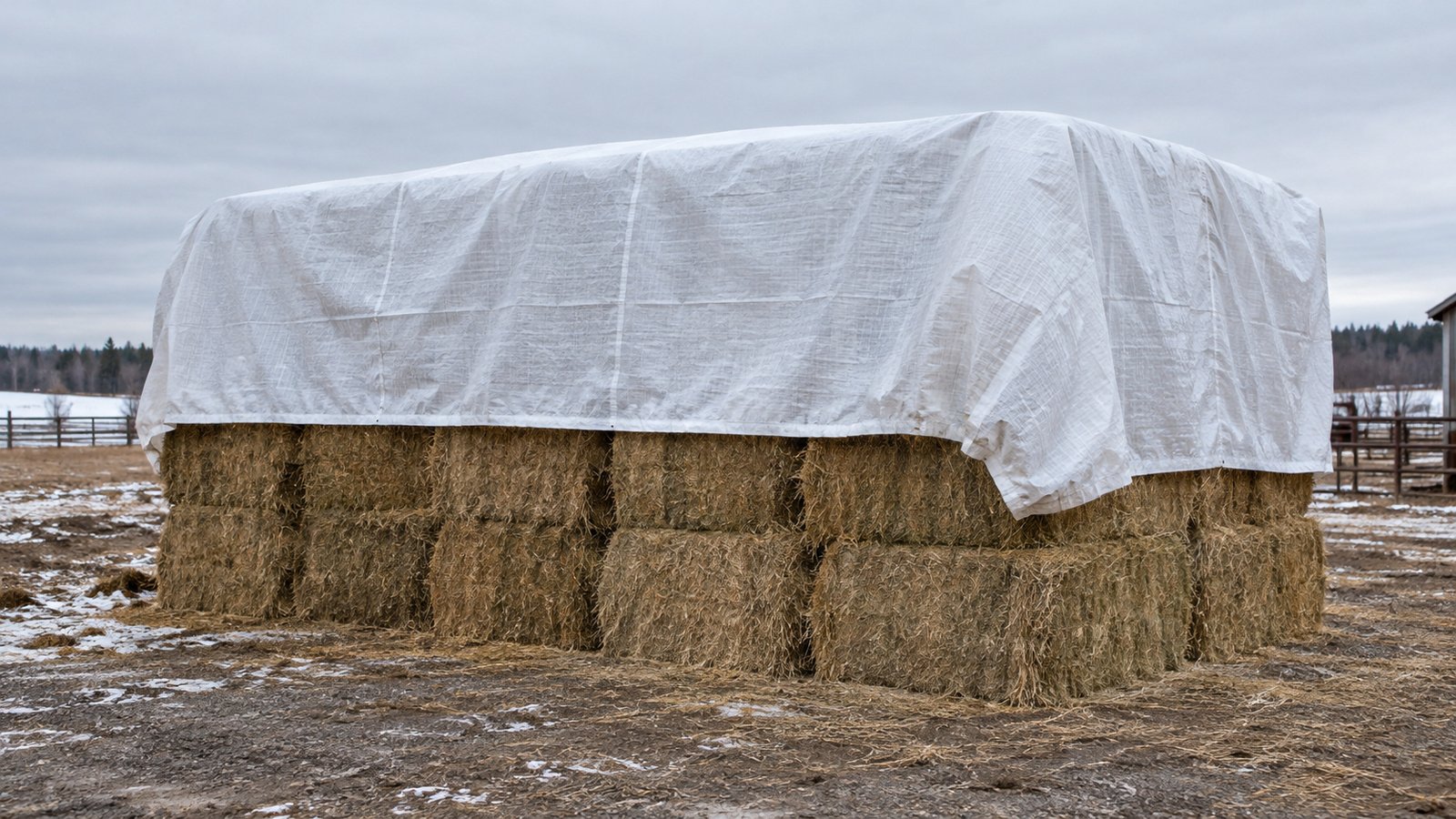
"Bale cover" and "bale wrap" get used as if they were the same thing. They are not, and ordering the wrong one is a common and expensive mistake.
A cover is a sheet that sits over a stack of bales. It is removable, reusable, and sized to the stack. A wrap is applied tightly to individual bales, usually by machine, and is generally destroyed when it comes off. Different products, different jobs, different economics.
This guide is about covers. We have written separately on how covers compare to wrap if that is the decision you are making.
Why woven polypropylene for a cover
A stack cover has to stay rigged for months, shed water continuously, and keep doing it as the stack settles underneath it. That puts a premium on dimensional stability.
Woven PP is made from flat polypropylene tapes woven over and under each other. The woven structure resists stretch in both directions, so a cover that was taut in October is still holding its shape in February. Thin unsupported film stretches under sustained load, and a stretched cover sags, ponds and flaps.
The difference tends not to show in the first season. It shows clearly in the second.
What to specify
Fabric weight
In GSM. It drives tear and puncture resistance in the body of the sheet. Ask for the number, not a grade name.
Hem
Folded and double-stitched on all four sides. The hem carries every load the tie-downs apply, and a heat-cut edge gives grommets nothing to pull against. This matters more than fabric weight, because the body of a cover rarely fails first.
Grommets
Metal, set through the reinforced hem, at consistent spacing. Specify spacing against your site exposure — closer on open ground where each tie point carries more load, wider where you are sheltered.
Reinforcement
Corner and ridge banding. Corners take the highest wind load; the ridge flexes most as the stack settles. Those are where covers break.
UV stabilisation
A HALS additive package for continuous outdoor exposure. Ask what is in the fabric. Be sceptical of advertised lifespans in hours — they assume a site, a latitude and a rigging standard the supplier has not seen.
Size
Stack dimensions, plus twice the side drop you want, plus roughly 30 cm per side for hem and tie-down. Full method in the sizing guide.
A specification you can send to a supplier
| Line | Example |
|---|---|
| Material | Woven polypropylene, flat tape |
| Fabric weight | State required GSM |
| Finished size | L × W flat, calculated from stack + drop + hem |
| Hem | Folded, double-stitched, all four sides |
| Grommets | Metal, through reinforced hem, spacing stated |
| Reinforcement | Corners and ridge |
| UV | HALS stabilised for outdoor service |
| Colour | White |
Two things the specification will not fix
A flat stack top. Any cover over a flat top ponds water, and ponded water finds every weakness there is. Crown the stack. It costs nothing.
Covering to the ground. Hay and soil both release moisture. Seal a stack to the ground and that moisture condenses under the cover overnight and falls back on the bales. Leave the bottom course or two open so air can move through the base.
Both of those are stacking decisions, not purchasing decisions, and both will undo a well-specified cover.
Reuse
A cover is an asset, not a consumable, which is most of the argument for one. Handle it accordingly: fold rather than drag it, keep it off sharp edges, pad protruding pallet corners before it goes on, and store it dry and out of sunlight between seasons. Most covers that fail in their second year were damaged in storage, not in service.