Woven polypropylene tarps for covering round and square bale stacks outdoors — sized to the stack, hemmed and grommeted for rope or strap anchoring.
A hay tarp has one job: keep precipitation off a stack that has to live outdoors until it is fed or sold. It sounds simple, and most of the cost of getting it wrong is invisible until you open the stack in February and find the top course spoiled, the outer bales grey, and a band of mould where water tracked down the side and sat against the bales.
Covering well is mostly about three decisions: how big the tarp is relative to the stack, how it is anchored, and how water gets away from the base once it runs off. Fabric comes fourth. A premium tarp that is too small, badly tied, or draped to the ground will lose more hay than a modest tarp sized and rigged properly.
The most common sizing mistake is measuring the footprint of the stack and ordering that. A tarp has to cover the top and come down the sides far enough that wind-driven rain does not blow in under the edge — then still have material left for the hem to be tied down. The usable coverage is always smaller than the flat dimensions.
The working rule: take the length and width of the stack, then add twice the amount of drop you want on each side, plus roughly 30 cm per side for the hem and tie-down. For a stack you intend to cover down to the second course, a drop of 1.0–1.5 m per side is typical.
| Stack (L × W) | Drop per side | Approx. flat tarp size | Typical use |
|---|---|---|---|
| 6 × 4 m | 1.0 m | ~8.5 × 6.5 m | Single row, round bales 2 high |
| 12 × 4 m | 1.0 m | ~14.5 × 6.5 m | Long single row, round bales |
| 12 × 6 m | 1.2 m | ~15 × 9 m | Double row or pyramid stack |
| 18 × 8 m | 1.5 m | ~21.5 × 11.5 m | Large square bale stack |
These are starting points, not a catalogue. Tell us the stack dimensions and how you stack — pyramid, flat-top, single row — and we will work the size back from that. Getting a tarp 2 m too short is the single most expensive mistake on this page.
A flat-topped stack holds water. Any tarp over a flat top will pond in the low spots, and ponded water finds every pinhole and seam eventually. A pyramid or ridged stack — even a modest crown of one bale — sheds water to the sides and roughly doubles the practical life of the cover.
If you can only change one thing about how you stack hay outdoors, crown the top. It costs nothing and it does more for the hay than upgrading the tarp.
"Heavy duty" is used loosely. For a woven polypropylene stack cover, it comes down to four things you can actually check on a spec sheet.
| Element | What to look for | Why it matters |
|---|---|---|
| Fabric weight | Quoted in GSM, not in vague grades | Tear strength and handling life track fabric weight closely. A light fabric is fine for a season; it is not fine for five. |
| Hem | Folded and double-stitched, not cut-and-sealed | The hem carries every load the tie-downs apply. A raw or heat-cut edge tears from the grommet outward. |
| Grommets | Metal, set through reinforced hem, spaced consistently | Grommet pull-out is the most common field failure, and it almost always starts at a corner. |
| Reinforcement | Extra banding at corners and along the ridge | Corners take the highest load in wind and are where tarps fail first. |
Wider grommet spacing means fewer tie points, which means each one carries more load. On an exposed site, closer spacing spreads the load and reduces the chance of a single corner letting go and taking the whole cover with it. On a sheltered yard you can run wider spacing without trouble.
Tell us the exposure when you ask for a quote. A tarp for a windbreak-sheltered yard and a tarp for an open prairie field are not the same specification, even at the same size.
Almost every failed hay tarp we hear about failed at the tie-down, not in the middle of the fabric. A few things make a disproportionate difference:
Hay gives off moisture, and so does the ground underneath it. Seal a stack all the way down and that moisture has nowhere to go: it condenses on the underside of the cover overnight and drips back onto the bales. Growers who tarp to the ground often find the bottom courses in worse condition than if the stack had been left open.
The practical answer is in how you cover, not in the fabric. Leave the bottom course or two uncovered so air can move through the base of the stack and carry moisture out. Stack on pallets, gravel or poles rather than directly on soil. Keep the cover off the ground on every side.
This is also why the drop figures in the sizing table above stop well short of ground level. Covering the top and shoulders of a stack while leaving the base open is deliberate, not a compromise.
Three things wear an outdoor cover out: ultraviolet exposure, mechanical flexing where it is loose, and handling damage when it goes on and comes off. UV stabilisation in the fabric addresses the first. The other two are site and handling questions.
We do not publish an hours figure or a guaranteed life, because the honest answer depends on your latitude, your exposure, how the stack is crowned, and whether the cover is re-tensioned. A cover that is kept taut on a crowned stack in a sheltered yard will outlast the same cover flapping on a flat-top stack in open country by a wide margin.
What we can tell you is the fabric specification, what UV stabilisation is in it, and what the construction details are. Ask and we will send the spec.
Four of those five are rigging and stacking problems, not fabric problems. That is the honest summary of this page.
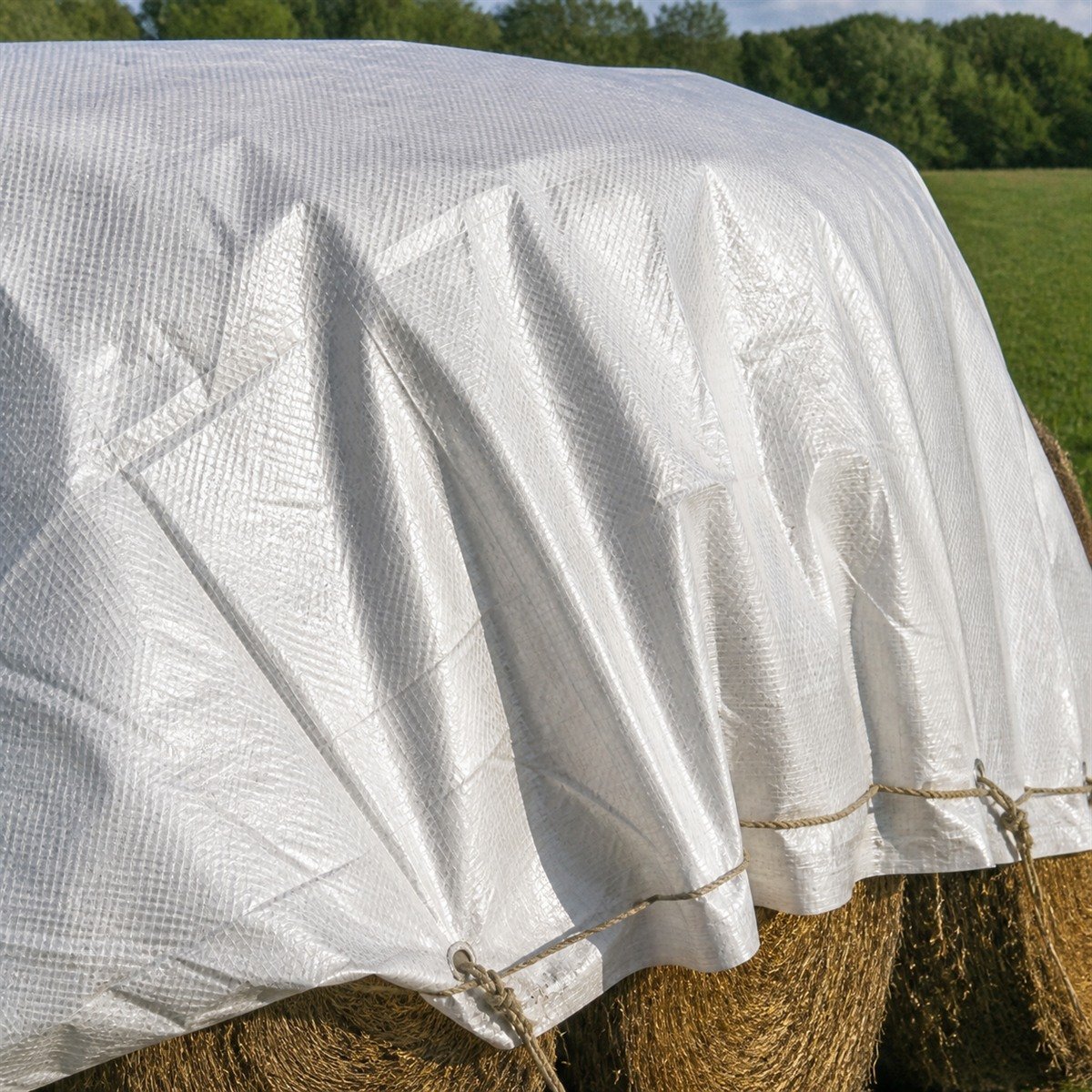
All specifications are fully customizable. Contact us to discuss your exact requirements.
| Material | Woven polypropylene (PP), flat-tape |
|---|---|
| Construction | Single-ply woven sheet, hemmed and grommeted |
| Hem | Folded and double-stitched on all four sides |
| Grommets | Metal, set through reinforced hem; spacing to site exposure |
| Reinforcement | Corner and ridge banding |
| UV Stabilization | HALS additive package for outdoor service |
| Sizing | Made to your stack dimensions and required side drop |
| Colour | White standard |
| Order Minimums | Contact us for minimum production quantity |
Single and double rows of round bales held outdoors through the winter.
Pyramid and flat-top square bale stacks on farm and at point of sale.
Covering the share of the crop that will not fit under a roof.
Protecting condition and colour on hay that has to look right when a buyer opens the stack.
Straw, haylage bales and other baled forage stored in the open.
More Products
The full range of woven polypropylene covers — stockpile, pallet, ground cover and lumber.
Learn More →Covers for aggregate, salt and bulk material stockpiles held outdoors.
Learn More →Woven PP ground cover for weed suppression and surface protection.
Learn More →Work from the stack, not the bales. Take the stack length and width, add twice the side drop you want, then roughly 30 cm per side for the hem and tie-down. For covering down to the second course, 1.0–1.5 m of drop per side is typical. Send us your stack dimensions and how you stack and we will size it with you — a tarp 2 m short is the most expensive mistake buyers make here.
No. Hay and the ground beneath it both give off moisture, and a stack sealed to the ground traps it — it condenses under the cover overnight and drips back onto the bales. Leave the bottom course or two open so air can move through the base. Cover the top and shoulders, not the whole stack.
Four things you can check on a spec sheet: fabric weight quoted in GSM rather than a vague grade, a folded and double-stitched hem rather than a heat-cut edge, metal grommets set through reinforced hem material, and extra banding at the corners and ridge. Corner grommet pull-out is the most common field failure, so the hem and corner spec matter more than headline fabric weight.
That depends on your latitude, exposure, whether the stack is crowned and whether the cover is re-tensioned — so we do not publish an hours figure or a guaranteed life. A taut cover on a crowned stack in a sheltered yard outlasts the same cover flapping on a flat-top stack in open country by a wide margin. We will send you the fabric specification and the UV stabilisation detail so you can judge it against your conditions.
Because the stack has a flat top. Any cover over a flat top will pond in the low spots, and standing water works at the weave and the seams until it finds a way through. Crowning the stack by even one bale sheds water to the sides and is the single cheapest improvement you can make to how long a cover lasts.
Yes. Large square bale stacks are if anything easier to cover well, because the stack geometry is regular and the cover sits more predictably. The same sizing approach applies: measure the stack, add drop per side, add hem allowance.
Rope through the grommets, never hooks biting into the fabric. Tension the long sides first and even out the slack before setting the corners, and do not pull it drum-tight — a slightly slack cover sheds wind load, while a tight one puts the whole shock into the grommets. Re-tension after the first week once the stack has settled.
Corner grommets, from wind load and uneven tensioning. After that: abrasion over a sharp bale edge or pallet corner, flexing along the ridge line as the stack settles, ponding on flat tops, and edges left flapping. Four of those five are rigging and stacking problems rather than fabric problems.
Woven polypropylene is dimensionally stable and does not stretch and sag the way thin unsupported film does, which matters on a cover that stays rigged for months and has to keep shedding water as the stack settles. The practical difference shows up in the second season rather than the first.
Yes — covers are made to the stack. Long single rows, double rows, pyramids and irregular yard layouts are all workable. Tell us the dimensions, how you stack and how exposed the site is, and we will quote against that rather than against a size chart.
Get a fast, no-obligation quote. We typically respond within 24 hours.