
What Makes a Hay Tarp Heavy Duty
"Heavy duty" appears on almost every tarp sold and means almost nothing. There are four things on a specification sheet that actually separate a cover that lasts from one that does not, and headline fabric weight is only one of them — and not the most important.

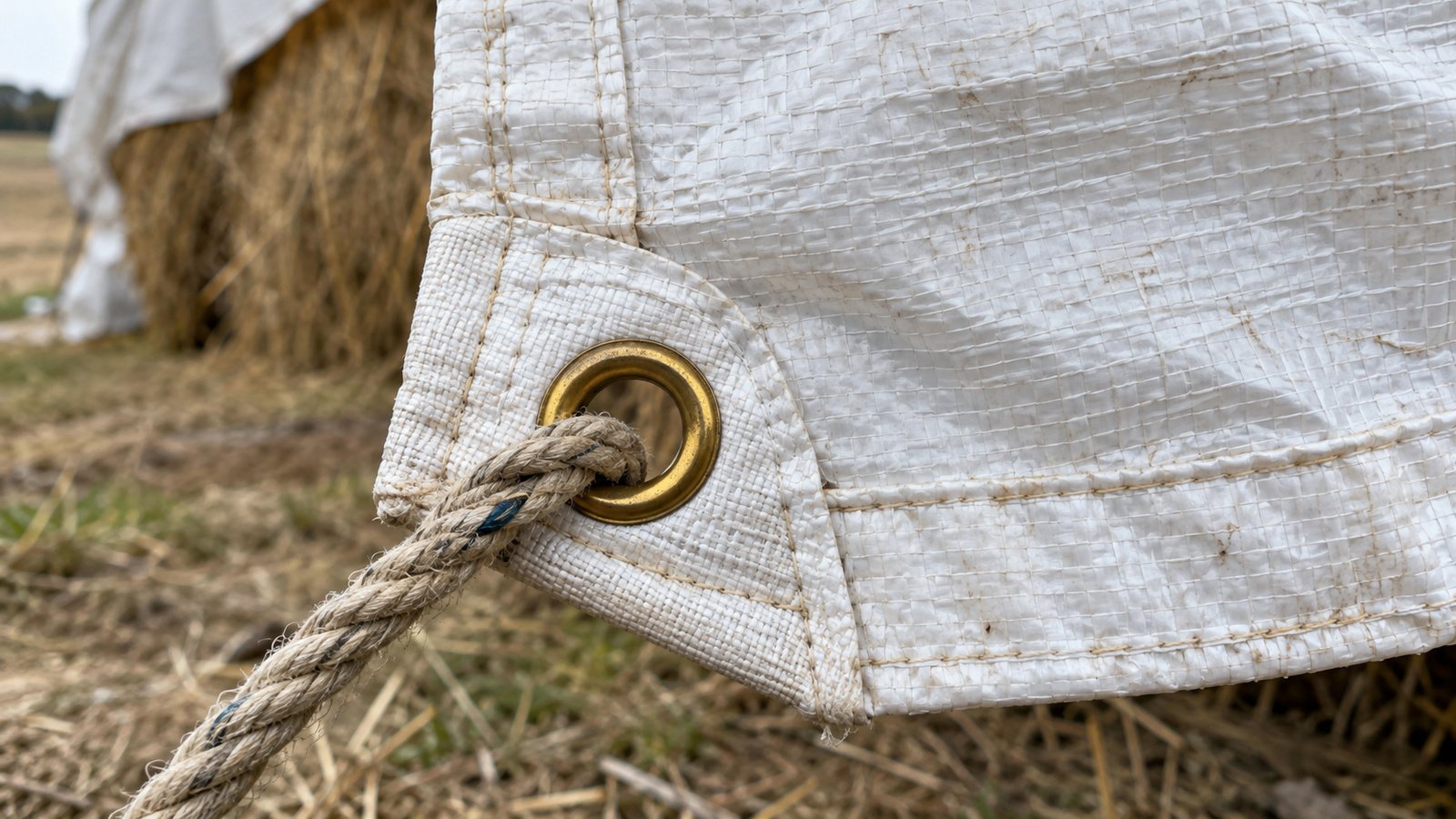
"Heavy duty" is on almost every tarp sold. It is not a specification, it is an adjective, and two covers both described that way can differ by a factor of three in how long they survive a Canadian winter.
Four things on a specification sheet actually separate them. Ask for all four and you can compare suppliers properly.
1. Fabric weight, stated in GSM
Grams per square metre is the only fabric figure that means anything. It is measurable, comparable across suppliers, and tracks tear strength and handling life closely.
If a supplier will not give you a GSM figure and instead offers a grade name, that is the answer to your question. Grades are internal to whoever invented them. GSM is not.
That said, GSM is where most buyers stop, and it is the reason they are disappointed. A heavy fabric with a badly made hem fails at the hem. Weight buys you resistance to abrasion and puncture in the body of the sheet — it does not buy you anything at the edges, which is where covers actually fail.
2. Hem construction
The hem is the folded and stitched band around the perimeter. Every tie-down load in the cover's life passes through it.
| Hem type | What happens in service |
|---|---|
| Folded and double-stitched | Load spreads along the fold and into the stitching. What you want. |
| Single-stitched fold | Workable, but a single thread line is a single point of failure. |
| Heat-cut / welded edge | No reinforcement. Grommets tear outward through the weave from the first serious gust. |
A folded, double-stitched hem on a mid-weight fabric will outlast a heat-cut edge on a heavy fabric, comfortably. This is the single biggest divergence between covers that look similar on a product page.
3. Grommets and how they are set
Grommet pull-out is the most common field failure of any stack cover, and it almost always starts at a corner.
What matters:
- Metal, not punched holes. A bare hole in woven fabric is a tear waiting for a reason.
- Set through the reinforced hem, not through single-layer fabric inboard of it.
- Consistent spacing. Irregular spacing means some tie points carry far more than others.
Spacing is a wind decision, not a cost decision
Wider spacing means fewer tie points, and each one carries proportionally more load. On an exposed site that concentration is what pulls corners out. On a sheltered yard behind a windbreak you can run wider spacing without trouble and save the money.
This is why we ask about exposure when quoting. A cover for an open field and a cover for a sheltered yard are genuinely different specifications at the same size.
4. Corner and ridge reinforcement
Failures are not evenly distributed. Corners take the highest load in wind, and the ridge line flexes most as the stack settles beneath it. Extra banding in those two places addresses where covers actually break, rather than adding uniform weight everywhere.
A cover with reinforced corners and a plain body will outlive a uniformly heavy cover with plain corners. Reinforcement is targeted; fabric weight is not.
What to ask a supplier
- What is the fabric weight in GSM?
- Is the hem folded and double-stitched, or heat-cut?
- Are grommets metal, and are they set through the reinforced hem?
- What is the grommet spacing, and does it change with site exposure?
- Is there corner and ridge reinforcement?
- What UV stabilisation is in the fabric?
Six questions. Any supplier who can answer all six is quoting you a real product. Any supplier who answers "it's heavy duty" to most of them is quoting you an adjective.
On service life claims
You will see covers advertised with specific outdoor lifespans. Treat them carefully. Service life depends on your latitude, your exposure, whether the stack is crowned, and whether the cover is re-tensioned after settling — none of which the supplier knows.
We give the fabric specification and the UV stabilisation detail and let you judge against your own conditions, rather than quoting a number that assumes a site we have not seen.