
Sourcing Lumber Wrap in Canada
Most lumber wrap gets reordered rather than sourced. Somebody specified a width and a fabric weight years ago, the PO repeats, and nobody revisits it until a shipment arrives water-stained or the wrapping line starts eating downtime on roll changes. This guide is about the questions worth asking when you do revisit it.

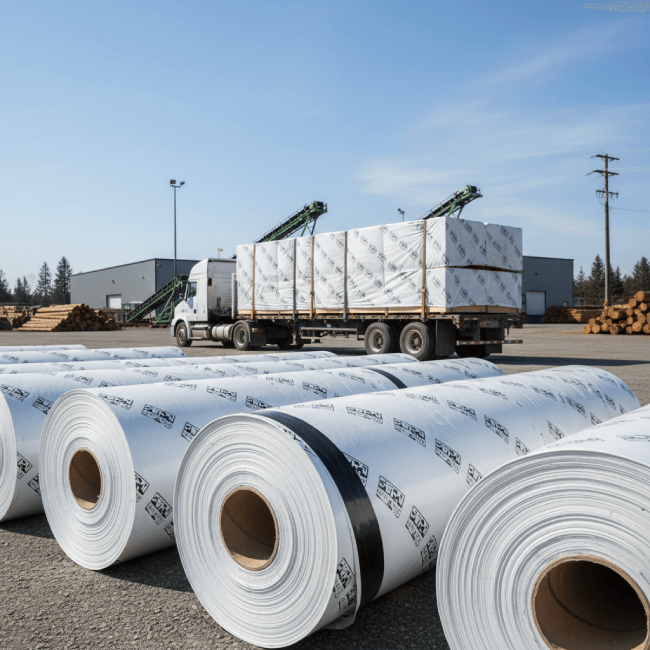
Most lumber wrap gets reordered rather than sourced. Somebody specified a width and a fabric weight years ago, the PO repeats, and nobody revisits it until a shipment arrives water-stained or the wrapping line starts eating downtime on roll changes. This guide is about the questions worth asking when you do revisit it.
It is written for Canadian sawmills, lumber yards, wood exporters and engineered-wood producers. For the technical specification side — fabric weight, failure modes, and what actually goes wrong in transit — see lumber wrap best practices and standards. This piece covers the supplier relationship instead.
Format first, specification second
Three formats dominate, and they are different handling models rather than quality tiers.
| Format | How it applies | Best fit |
|---|---|---|
| Flat roll | Cut to length, wrapped and secured | Mixed product sizes, manual or semi-automated operations |
| Tubular sleeve | Bundle slides into a continuous tube | Standardised bundle dimensions, fastest application |
| Half sleeve | Covers top and sides, open base | Irregular or oversized loads, partial protection |
Tubular sleeves are the fastest application method if your bundles are consistent. The moment your product mix varies, the sleeve size that fits your standard bundle is wrong for everything else, and flat roll becomes the more economical choice because you cut what each load needs.
A supplier who asks what your bundle mix looks like before recommending a format is doing the job properly. One who quotes the format you named without asking is taking an order.
Width matching, and the cost of getting it wrong
Width is where money quietly leaks. Too narrow and you are double-wrapping or leaving exposed faces. Too wide and you are paying for material you fold over and discard on every single bundle.
Wide-format flat roll — nine feet and similar — covers standard dimensional bundles and oversized engineered panels in a single pass, which removes the seam that water finds on a two-pass wrap. Narrower widths make sense for smaller, consistent product.
Worth measuring your actual bundles before the next order rather than trusting the width on the existing PO. Bundle dimensions drift as product mix changes, and the wrap spec often does not follow.
Roll length is a labour question
This is the specification line most often ignored and the one with the clearest operational payback.
Every roll change on an automated wrapping line is downtime: stop, unload, mount, thread, restart. Longer rolls mean fewer changes across the same volume of product. On a high-throughput line the difference between a short roll and a long one, counted across a year, is measured in shifts rather than minutes.
The constraint is your equipment — mandrel capacity, roll weight, and what your crew can safely handle. Ask what the longest roll your line can take actually is, then buy that rather than whatever length has been arriving.
Ask how UV stabilisation is achieved
Lumber wrap sits outdoors, often for a full season in a yard, sometimes longer on an export lane. UV performance matters, and it is the area where supplier claims are vaguest.
The question worth asking is not "is it UV treated?" but how. There is a real difference between a stabiliser compounded into the polypropylene resin during manufacture and a treatment applied to the fabric surface afterwards. A compounded additive package runs through the fabric; a surface treatment can wear.
Our standard wrap uses a HALS (Hindered Amine Light Stabilizer) additive package compounded into the resin during manufacture. Enhanced UV packages are available for export yards and southern lanes where exposure is longer or more intense.
Be sceptical of precise longevity figures offered without a test basis. Real-world performance depends on latitude, season, orientation and how long the bundle actually sits, and a number quoted without those conditions is not telling you much.
Breathability is the whole argument against stretch film
Freshly milled lumber carries moisture and continues to release it. Wrap a bundle in polyethylene stretch film and that moisture has nowhere to go: it condenses inside the wrap, runs back onto the wood, and produces the staining and mould that take a bundle down a grade.
Woven polypropylene sheds rain from outside while letting vapour move out from inside. It also survives handling — forklift tines, sharp bundle edges, banding — in a way film does not.
The per-bundle material cost is higher. The comparison that matters is against the cost of downgraded lumber, which is not close in any active yard. We set the comparison out in full at woven PP vs poly tarp.
Printing: grade marks and branding
Up to six-colour flexographic printing is applied inline during manufacture and does not affect fabric performance, UV resistance or breathability. Mills use it for company identification, grade stamps, handling instructions and destination marking.
Two practical notes. Printed runs carry production minimums, so printing suits steady-volume operations rather than occasional orders. And if you are printing grade information, confirm who is responsible for the accuracy of what goes on the wrap — that is a mill responsibility, not a packaging one, and it should be clear in writing.
Export: what ISPM 15 does and does not cover
A recurring confusion worth settling. ISPM 15 governs wood packaging material — pallets, crating, dunnage — requiring treatment and the IPPC mark. Plastic wrap is not wood packaging material, so the standard does not apply to the wrap itself.
What it does not do is exempt your shipment. The lumber being shipped carries its own phytosanitary requirements by destination, and any wooden dunnage inside the load is in scope. The wrap is simply not the thing being regulated. There is more on this in five procurement mistakes on lumber wrap orders.
Landed cost, in Canadian dollars
The unit price on a wrap quote is rarely the number that matters. Ask every supplier to quote delivered to your mill, in CAD, with:
- Freight to your site — LTL or full truckload, not to a port or a depot
- Customs brokerage — handled by the supplier, or billed to you separately later
- CUSMA documentation — correct duty treatment on cross-border movement
- Currency — CAD invoicing, or a USD quote plus exchange exposure between order and settlement
Quotes become comparable immediately once all four are in the same place.
A supplier checklist
- They asked about your bundle mix and wrapping equipment before recommending a format
- They can explain how UV stabilisation is achieved, not just assert that it exists
- Roll length was discussed against your line capacity
- A Certificate of Conformance comes with every order as standard
- Mill test data — fabric weight, tensile, UV stabilisation — is available on request
- They quoted delivered, in CAD, with brokerage and CUSMA documentation accounted for
- They will supply a single roll as readily as a container, so you can trial before committing
That last point separates suppliers worth trialling from ones that are not. Testing a roll through your own line for a week tells you more than any specification sheet.
Supply in Canada
Sackora is a Canadian corporation, incorporated in 2007, supplying woven polypropylene lumber wrap to sawmills, lumber yards, wood exporters and engineered-wood producers from our Richmond Hill, Ontario warehouse. Our founder brings more than 20 years of specialist expertise in woven polypropylene procurement and mill sourcing.
Flat rolls, tubular sleeves and half sleeves, in standard and custom widths, with anti-slip, lamination and up to six-colour print options, are covered at lumber wrap. Cross-border shipments move on CUSMA-compliant documentation with customs brokerage handled in-house.