
Woven Poly Potato Bags — Ventilation, Light and Storage Life
Potato packaging has to do two things that pull directly against each other. Potatoes are alive after harvest — they respire, giving off heat, moisture and carbon dioxide — so the bag has to breathe. But light turns potatoes green and bitter, so the bag also has to shade them. Every potato bag on the market is a compromise between those two requirements.

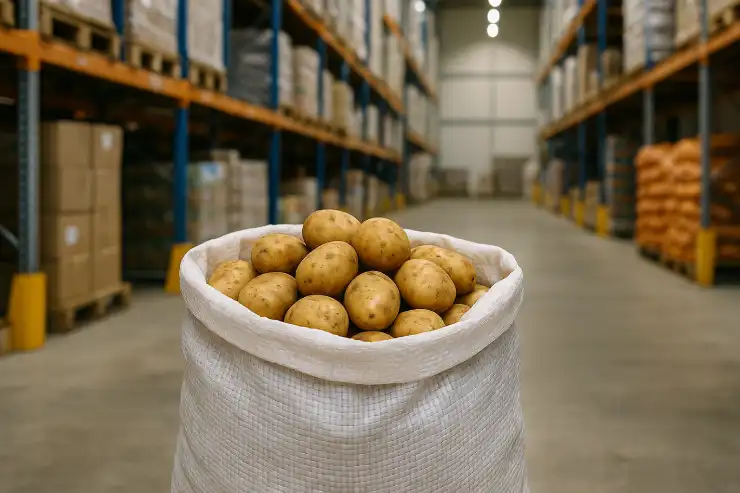
Potato packaging has to do two things that pull directly against each other. Potatoes are alive after harvest — they respire, giving off heat, moisture and carbon dioxide — so the bag has to breathe. But light turns potatoes green and bitter, so the bag also has to shade them. Every potato bag on the market is a compromise between those two requirements.
This guide covers how that compromise gets made in practice, for growers, packers and distributors moving table stock, seed, and processing potatoes in Canada.
Requirement one: the crop has to breathe
A harvested potato continues to respire. That produces three things the packaging has to let out:
- Heat — a sealed pallet of potatoes warms itself from the inside
- Moisture vapour — which condenses on any cool impermeable surface and runs back onto the tubers
- Carbon dioxide — which accumulates in still air
Pack potatoes in sealed polyethylene and you get free water inside the bag within days, then soft rot. This is why the category uses open-structure fabric rather than film, and why a solid unlaminated woven bag is often still not open enough on its own.
Requirement two: light causes greening
Potatoes exposed to light — daylight or retail display lighting — develop chlorophyll and turn green at the surface. The chlorophyll itself is harmless. The problem is that the same light exposure promotes glycoalkaloid development, which tastes bitter and is undesirable in quantity. Greening is the visible marker for a change you cannot see.
That is why the most open packaging structure is not automatically the best one. A wide-open mesh bag sitting under retail lights for two days is doing real damage to the product inside it.
The category solves this three ways, and most packers use more than one:
- Dark storage and transit — the primary control, and the reason bulk movement can use very open fabric
- A printed band or panel across a mesh bag, shading a portion of the contents while leaving the rest open
- Solid fabric with mesh panels, rather than mesh throughout
The three formats
| Format | Airflow | Light protection | Typical use |
|---|---|---|---|
| Leno mesh | Highest — open weave throughout | Minimal on its own | Retail consumer packs, onions and potatoes in dark storage |
| Ventilated woven PP | Good — solid fabric with mesh panels | Good across the solid areas | Larger packs, longer storage, more print area |
| Ventilated FIBC | Good — mesh sidewall strips | Good | Bulk movement, grower to packhouse or processor |
Leno mesh is the familiar open-weave consumer bag. It maximises airflow and lets the buyer see the product, which is commercially useful. Its weakness is light, so it is best paired with a printed band and a short retail dwell.
Ventilated woven PP puts mesh panels into otherwise solid fabric. You lose some airflow relative to full mesh and gain shading plus a printable surface — a reasonable trade for larger pack sizes and longer storage.
Ventilated FIBC is how bulk volume moves. Mesh strips are woven into the sidewalls, giving airflow through a bag carrying several hundred kilograms. For a grower moving product to a packhouse or a processor, this replaces both the pallet box and the handling that goes with it.
Storage conditions the bag cannot fix
Packaging supports storage; it does not substitute for it. Three things matter more than the bag:
Curing after harvest. Newly harvested potatoes are typically held warm and humid for a couple of weeks so wounds suberise and skins set. Bagging tightly before curing traps the moisture this process releases.
Temperature, matched to end use. Table stock is commonly held around 7–10 °C. Seed potatoes go colder. Processing potatoes destined for fries or chips need to stay in the table-stock range or warmer, because cold storage triggers sweetening — starch converts to reducing sugars, and those sugars brown during frying, giving dark product that gets rejected. A grower who stores processing potatoes at seed temperatures has a quality problem no packaging can correct.
High humidity with moving air. Potatoes shrink and go soft in dry storage, so humidity is kept high — but high humidity in still air condenses. Storage design has to deliver both, and ventilated packaging is what lets that airflow reach the tubers rather than just passing around the pallet.
Provincial agriculture extension services publish storage guidance specific to Canadian growing regions and varieties, and the Canadian Food Inspection Agency sets the grading and labelling requirements that apply to what goes on the bag.
Specifying a potato bag
- Pack weight and target dimensions
- Structure — leno mesh, ventilated woven, or ventilated FIBC
- Light management — printed band coverage, or mesh panel layout on solid fabric
- Print — colour count, plus the CFIA-required grade and origin information
- Closure — sewn, taped, or clipped, and whether it runs on your existing equipment
- Handling — whether bags are stacked, palletised, or bulk-filled, and expected storage duration
Storage duration is the item most often left out and the one that changes the recommendation most. A bag that ships and sells within a week is a different specification from one holding product through a winter.
Supply in Canada
Sackora supplies woven polypropylene packaging to Canadian potato growers, packers and processors from our Richmond Hill, Ontario warehouse — mesh and ventilated bag formats, and ventilated FIBC for bulk movement. Application detail sits at potato packaging, with the full bag range at PP woven bags.
Tell us your pack weight, how long product sits in storage, and whether it is table stock, seed or processing, and we will come back with a format recommendation and pricing.