
Tile Adhesive Bags — Packaging Polymer-Modified Dry Mix
Tile adhesive is more sensitive to packaging than plain cement is. A cementitious tile adhesive carries redispersible polymer powder, cellulose ethers and other additives that give it its bond strength and open time — and those additives are more vulnerable to humidity than the cement fraction they sit alongside.

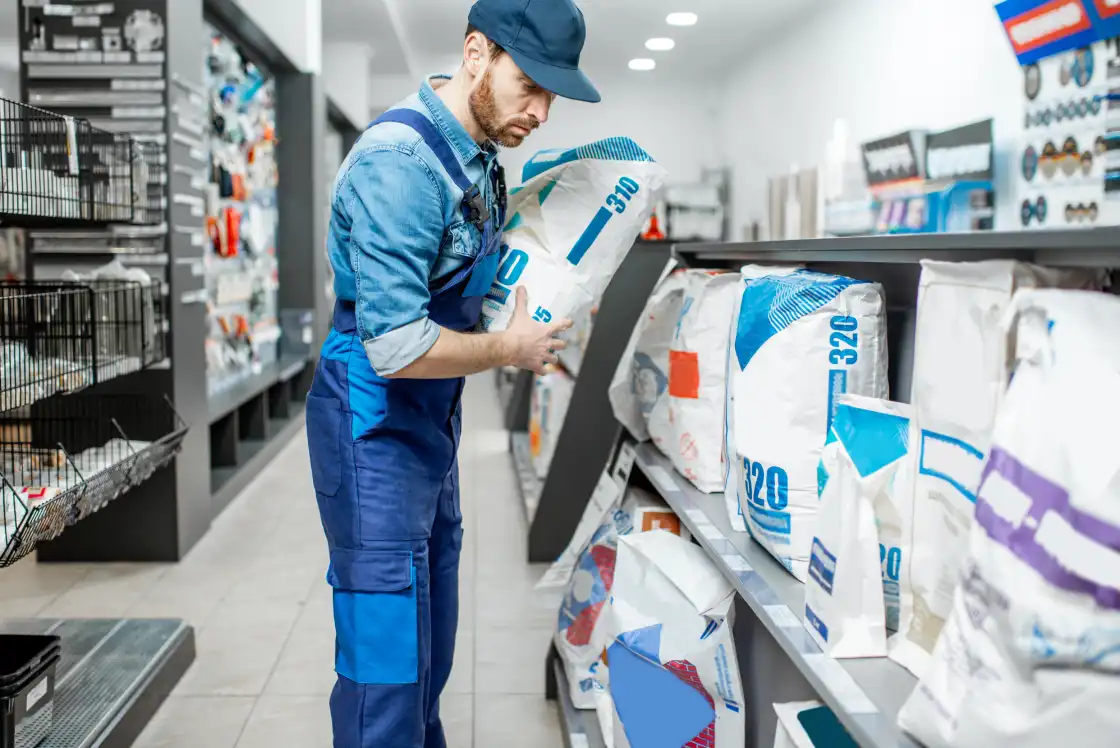
Tile adhesive is more sensitive to packaging than plain cement is. A cementitious tile adhesive carries redispersible polymer powder, cellulose ethers and other additives that give it its bond strength and open time — and those additives are more vulnerable to humidity than the cement fraction they sit alongside.
That changes the packaging brief. With plain cement, moisture ingress eventually gives you lumps you can see. With polymer-modified adhesive, moisture can degrade performance while the powder still looks perfectly normal in the bag. The failure shows up on a tiler's wall, weeks later.
Much of the groundwork here is shared with cement packaging, which we cover in PP bags for cement. This piece covers what is different.
Why polymer-modified mix is the harder case
A typical cementitious tile adhesive contains, alongside cement and graded sand:
- Redispersible polymer powder — provides flexibility and adhesion to non-porous substrates
- Cellulose ether — controls water retention, open time and slip resistance
- Other functional additives — set modifiers, air entrainers, fibres depending on the formulation
These are hygroscopic. They pick up ambient moisture readily, and once they have, the properties they were added to deliver drift. The adhesive may still mix and still trowel, but open time shortens or bond strength falls below the class it was sold as.
The performance classes themselves come from ISO 13007, the international standard for ceramic tile adhesives and grouts — the C1, C2, and S1/S2 designations printed on the bag. A producer who declares a class on the packaging needs packaging that protects the product to that class through distribution and shelf life.
Construction: laminated, de-aerated, sift-proof
The baseline specification for polymer-modified dry mix is laminated woven polypropylene.
| Requirement | Specification | Why it matters here |
|---|---|---|
| Moisture barrier | PE or BOPP lamination | Protects the polymer fraction, not just the cement |
| De-aeration | Micro-perforated laminate | Laminated fabric is not porous; air must still escape at filling |
| Seam construction | Sift-proof | Fine powder escapes ordinary stitching and dusts the shelf |
| Anti-slip | Surface treatment | Pallet stability through distribution and in-store stacking |
| BOPP, multi-colour | Class, batch code and brand must stay legible |
The de-aeration point catches producers moving from paper to woven PP. Paper is naturally porous, so air leaves through the bag wall during filling. A laminated woven bag is sealed by design and needs engineered micro-perforation to fill at line speed. It is a specification item — ask for it by name.
The retail dimension
Cement often moves in trade quantities to contractors who do not care what the bag looks like. Tile adhesive frequently sells off a shelf in a tile shop or a big-box aisle, next to three competing brands, to a buyer who is comparing them visually.
That makes print quality a commercial requirement rather than a cosmetic one, and it is the main reason BOPP lamination is common in this category. BOPP gives a smooth, high-gloss printable surface that carries photographic images and fine text far better than direct printing onto woven fabric.
Three things that need to survive the whole journey:
- The ISO 13007 class designation — this is a performance claim and it must remain readable
- Batch and date coding — traceability, and shelf-life management at the retailer
- Mixing instructions — water ratio and pot life, usually the most-read text on the bag
Print that scuffs off during palletised transit defeats all three. Specify abrasion resistance alongside colour count.
Bag format and handling
Tile adhesive is commonly packed in 20 kg and 25 kg units — small enough for one person to carry up a stairwell to a job. That is a different handling profile from a bulk cement pallet, and it shows up in the specification:
- Open-mouth construction is usual, giving a flat, printable face and flexibility across fill weights in a product range with many SKUs
- Carry handles or easy-open features appear on retail-focused lines; both are worth specifying up front because they affect the bag layout, not just the finish
- Block-bottom formats stand squarely on a shelf and stack tidily — see block-bottom bags
- Gusseted formats give more volume without more height, useful for lower-density formulations — see gusseted bags
Shelf life and storage guidance
Because these products carry a declared shelf life, the packaging has to hold up for that entire period rather than just through delivery. Two practical consequences:
First, the barrier needs to withstand warehouse conditions that are frequently not climate-controlled, through seasonal humidity cycles. Second, storage guidance printed on the bag — keep dry, keep off the floor, use within the stated period — should match what the bag can actually deliver. Printing a twelve-month shelf life on packaging specified for three months of protection is a warranty problem waiting to happen.
For pallets that will sit in a yard or an unheated store, a pallet cover handles the weather so the individual bag barrier does not have to work alone.
What to send with an enquiry
- Fill weight and SKU range
- Formulation type — cementitious, polymer-modified, and the declared ISO 13007 class
- Declared shelf life
- Filling equipment and line speed
- Print requirements — colour count, and whether it is trade or retail presentation
- A sample or photo of your current bag
Supply in Canada
Sackora supplies woven polypropylene packaging for tile adhesive, grout, render and dry-mix products to Canadian producers, shipping from our Richmond Hill, Ontario warehouse. Laminated, printed, block-bottom, gusseted and valve configurations are covered under PP woven bags, with application detail at tile adhesive packaging.