
PP Bags for Cement — A Specification Guide
Cement packaging has one job above all others: keep water away from the product. Cement hydrates on contact with moisture, and a bag that lets humidity through does not merely look bad on a pallet — it delivers partially set product that will not perform. Everything else in a cement bag specification follows from that.

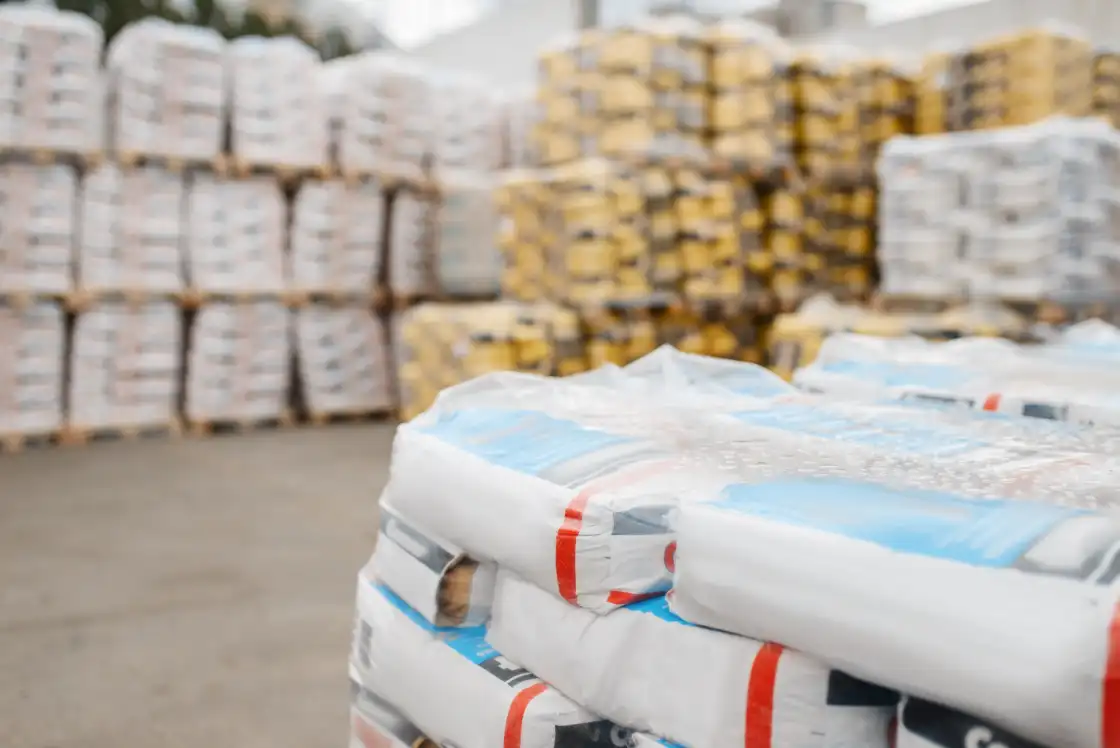
Cement packaging has one job above all others: keep water away from the product. Cement hydrates on contact with moisture, and a bag that lets humidity through does not merely look bad on a pallet — it delivers partially set product that will not perform. Everything else in a cement bag specification follows from that.
This guide covers the decisions that actually change the outcome when specifying woven polypropylene bags for cement, mortar, grout and similar cementitious powders.
Why the moisture barrier drives everything
Portland cement in Canada is governed by CSA A3000, the cementitious materials compendium. That standard governs the cement, not the packaging — but it is the reason packaging matters. A product that meets the standard leaving the plant and absorbs moisture in a warehouse no longer performs to it on site.
Moisture reaches cement in a bag three ways: ambient humidity passing through the bag wall, liquid water from rain or condensation on outdoor pallets, and vapour cycling in and out as temperature swings day to night. A woven bag with no barrier layer stops none of these particularly well. That is the gap lamination closes.
Lamination: the single most important decision
| Construction | Moisture barrier | Typical use |
|---|---|---|
| Unlaminated woven PP | Poor — the weave passes vapour freely | Aggregates, products indifferent to humidity |
| PE-laminated woven PP | Good — a polyethylene film layer bonded to the fabric | Standard cement, mortar, grout packaging |
| BOPP-laminated woven PP | Good barrier plus a high-quality printable surface | Retail and branded bags where shelf appearance matters |
For bulk trade cement moving to contractors, PE lamination is the workhorse. For bagged product going to retail shelves where print quality sells the bag, BOPP lamination earns its premium on appearance rather than on performance.
The trade-off nobody mentions at quote stage is the one in the next section.
De-aeration: the problem lamination creates
This is the part of cement packaging that surprises buyers coming from paper.
Cement is filled fluidised — aerated so it flows like a liquid. When it enters the bag, a large volume of air has to leave, and it has to leave fast enough to keep up with the filling line. Multiwall kraft paper handles this naturally because paper is porous. A laminated woven PP bag is, by design, not porous.
Laminated cement bags therefore need engineered de-aeration, normally fine micro-perforation of the laminate. Specify it and the bag fills at line speed and settles into a tidy brick shape on the pallet. Leave it out and you get slow fills, incomplete fills, and bags that balloon and then slump.
Two questions to put to any supplier quoting laminated cement bags:
- What is the de-aeration method, and what perforation pattern comes with it?
- What filling equipment and line speed is the bag specified for?
A supplier who cannot answer the second question has not specified a cement bag — they have quoted a bag that happens to hold cement.
Valve or open mouth
Valve bags are closed on all sides with a small filling valve in one corner. The filling spout enters the valve, the bag fills, and product pressure closes the valve. No sewing or sealing step is needed after filling, which is why valve bags dominate automated high-volume cement lines.
Open-mouth bags are filled through the top and then sewn or heat-sealed closed. They tolerate variable fill weights and mixed product runs, which suits smaller operations and specialty products more than they suit a dedicated cement line.
| Valve | Open mouth | |
|---|---|---|
| Filling speed | High, automated | Moderate |
| Closing step | None required | Sewing or heat seal |
| Fill weight flexibility | Fixed to the line | Flexible |
| Dust at filling | Lower | Higher |
| Best fit | Dedicated cement lines | Mixed or lower-volume production |
Both are supplied in woven PP: valve-top bags and open-mouth bags. If you are running a dedicated line, the valve type and dimensions need to match your filling spout, so send the equipment details with the enquiry rather than after the first sample.
Sift-proofing matters more with cement
Cement is ground extremely fine. Particles that would never escape a seam on a granular product will find their way through ordinary stitching on a cement bag, which gives you three problems: product loss, dusty pallets that nobody wants to handle, and bags that look damaged when they are not.
Sift-proof construction addresses this at the seam — through tape-over-stitch, hot-air sealing, or an inner barrier depending on the bag. It is worth naming explicitly on the specification. "Sewn" on its own does not tell you whether the seam will hold fine powder.
Anti-slip and pallet stability
Woven polypropylene is a slippery fabric. Stack laminated PP bags on a pallet without treatment and they behave like a deck of cards on the first hard brake.
Anti-slip treatment — a coating applied to the bag surface that raises the coefficient of friction between layers — is the standard answer, and it is a specification item rather than something you should assume is included. On outdoor or long-haul pallets it pairs with a stretch hood or pallet cover, which handles the weather that the individual bag barrier should not have to.
Putting a cement bag specification together
A complete enquiry for cement packaging should state:
- Fill weight and target bag dimensions
- Bag type — valve or open mouth, and the valve dimensions if applicable
- Fabric weight in GSM
- Lamination — PE or BOPP, with the de-aeration requirement stated
- Seam construction — sift-proof, and by which method
- Anti-slip — yes or no
- Print — number of colours, and whether the surface is BOPP or direct-printed woven
- Filling equipment — make, model and line speed
The last item is the one most often left out and the one that most often causes a second sample round.
Supply in Canada
Sackora supplies woven polypropylene bags for cement, mortar, grout and dry-mix products to Canadian construction material producers, shipping from our Richmond Hill, Ontario warehouse. Configuration options — laminated, valve-top, open-mouth, gusseted, and up to six-colour print — are covered under PP woven bags, with the application detail at cement packaging.
Send your fill weight, filling equipment, and a photo of your current bag. That is usually enough for us to come back with a specification and pricing.