
One Tonne Bulk Bags — A Buyer's Guide
"One tonne bag" describes a safe working load, not a size, and the two get conflated constantly. A bag rated for 1,000 kg may be nowhere near big enough for a tonne of your material — or it may be twice the size you need. The rating and the volume are separate decisions.

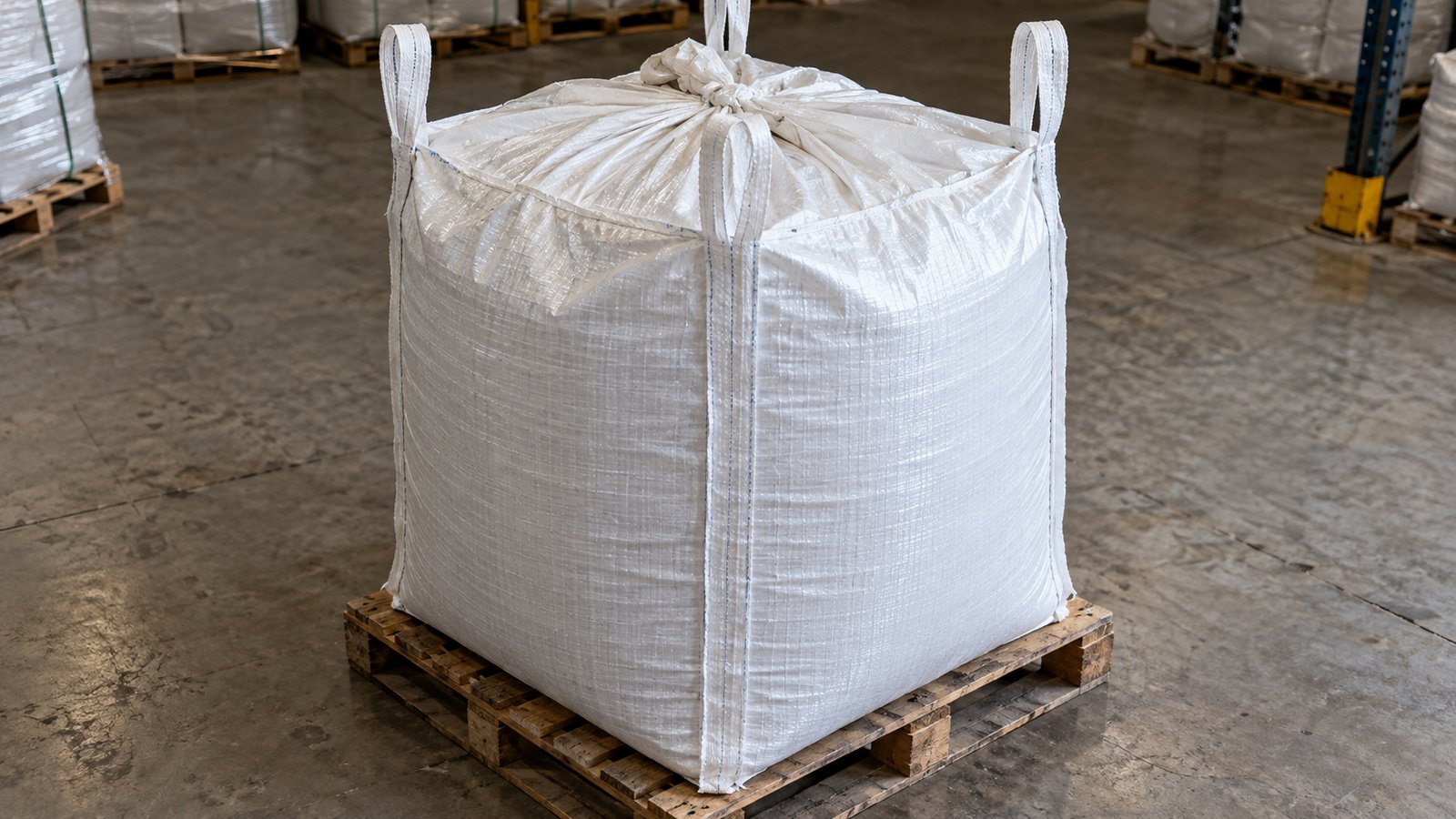
"One tonne bag" is used as though it described a size. It does not. It describes a safe working load, and the physical volume of the bag is a separate question driven entirely by what you are putting in it.
Conflating the two is the most common reason a bulk bag order turns out wrong.
Safe working load is a weight rating
Safe working load — SWL — is the maximum weight the bag is designed to carry in normal use. A 1,000 kg SWL bag is rated to carry a tonne safely, repeatedly, through normal lifting and handling.
It says nothing about how much space a tonne of your material occupies.
Safety factor is the number that matters
Safety factor is the ratio between the load at which the bag actually fails in testing and its stated SWL.
A 5:1 safety factor on a 1,000 kg SWL bag means it was tested to withstand 5,000 kg before structural failure. A 6:1 bag was tested to 6,000 kg.
| Safety factor | Typical use |
|---|---|
| 5:1 | Standard single-trip bulk handling |
| 6:1 | Multi-trip bags, and applications involving lifting over personnel |
That margin is not decoration. Real handling involves dynamic loading — a bag snatched off the ground by a forklift sees forces well above its static weight, and a bag that is scuffed, UV-aged or has been round the yard a few times is not at its as-manufactured strength.
If anyone lifts over people, or the bag will be reused, the safety factor is not a place to economise.
Volume is a density calculation
Here is where orders go wrong. Work out the volume your material occupies at the weight you want to carry:
Volume (m³) = fill weight (kg) ÷ bulk density (kg/m³)
A standard 90 × 90 × 110 cm bag holds roughly 0.89 m³ when filled to the top. So:
| Material | Approx. bulk density | 1,000 kg occupies | Fits a standard bag? |
|---|---|---|---|
| Wood pellets | ~650 kg/m³ | 1.54 m³ | No — needs a larger bag |
| Grain | ~750 kg/m³ | 1.33 m³ | No — needs a larger bag |
| Dry sand | ~1,600 kg/m³ | 0.63 m³ | Yes, with room to spare |
| Mineral concentrate | ~2,500 kg/m³ | 0.40 m³ | Yes — less than half full |
Two opposite failure modes fall out of this. Light materials run out of bag before they reach the weight rating — you need a bigger bag, not a stronger one. Dense materials hit the weight limit at less than half the bag's volume, and a bag only 40 % full is unstable to lift and awkward to stack.
For genuinely dense material, a smaller bag at the same SWL is usually the better specification.
What to ask for
- SWL and safety factor, stated separately
- Test documentation to ISO 21898 — the standard for FIBC testing. A number on a label is not a test report.
- Fabric weight in GSM
- Lifting loop configuration and how loops are attached
- Top and bottom construction — duffle top, open top, spout bottom, flat bottom
- Liner, if the product needs one
- UV stabilisation, if the bags will sit outdoors
The sizing conversation to have
Tell a supplier your material, its bulk density, your target fill weight, and how the bag is filled and discharged. Those four facts determine the specification.
Asking for "a one tonne bag" gives a supplier only one of the four, which is why the first quote so often turns out to be for the wrong bag.