
Sizing Lumber Bundle Covers by Bundle Dimension
A lumber bundle cover is sized from the path the fabric travels over the bundle, not from the bundle's footprint. Get that wrong and you either pay for material that hangs useless at the bottom, or you discover on the packing line that the cover does not reach.

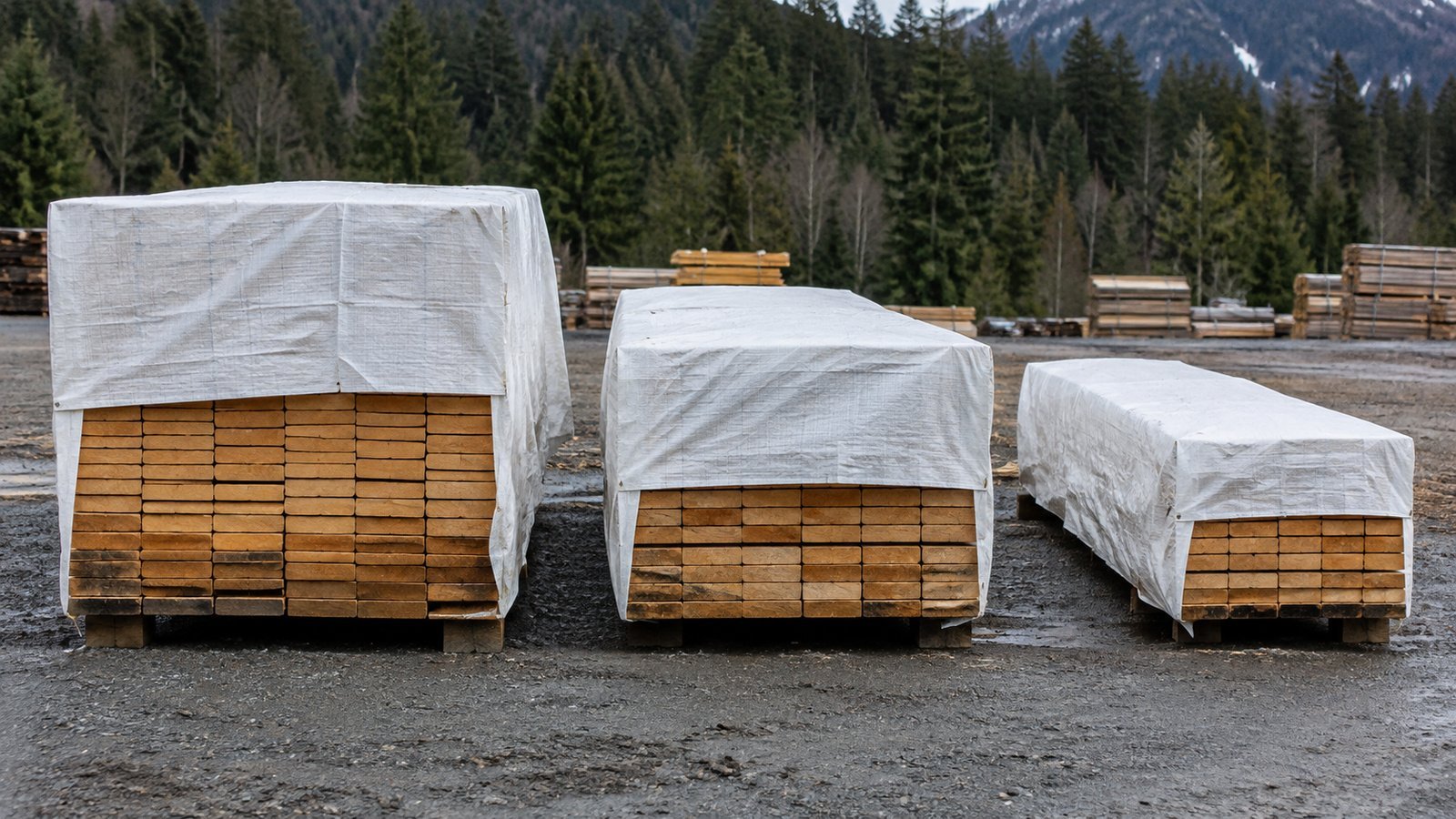
Bundle cover sizing looks like it should be simple arithmetic, and it is — but only once you are measuring the right thing. The common error is to size from the bundle footprint, as though the cover were a lid. It is not. It is a sheet that travels over the top and down both sides, and the dimension that matters is the length of that path.
Width: the path over the bundle
Lay a tape across the bundle the way the fabric will sit: up one side, across the top, down the other side. That measurement is your minimum cover width.
Cover width = bundle width + (2 × side coverage)
Side coverage is how far down each side you want the fabric to reach. For most mill and export specifications that is the top and sides down to somewhere above the bottom course — not all the way to the stickers or the forks.
| Bundle W × H | Side coverage | Minimum cover width |
|---|---|---|
| 1.2 × 1.0 m | 0.7 m | 2.6 m |
| 1.2 × 1.2 m | 0.9 m | 3.0 m |
| 1.5 × 1.2 m | 0.9 m | 3.3 m |
| 1.5 × 1.5 m | 1.2 m | 3.9 m |
Why not cover to the ground?
Three reasons. Fabric below the bottom course does no protective work, because water running down the side has already left the timber by then. It gets caught by forks and torn during handling. And it traps air and moisture against the lowest boards, which is the part of a bundle most likely to discolour.
Coverage that stops above the bottom course is deliberate. It is not a cost compromise.
Length: bundle length plus overhang
Straightforward, with one caveat. Add enough overhang at each end to secure the cover, but be clear about whether the ends are open or closed, because they are different products.
- Open ends. The standard for most lumber. The bundle ends are exposed, which lets moisture in the timber escape rather than condensing inside a sealed package.
- Closed ends. A tubular or capped configuration enclosing the whole bundle. Specified where contamination or driving rain at the ends is the concern, and worth thinking about carefully — a fully enclosed bundle has nowhere for internal moisture to go.
If nobody has made that decision explicitly on your spec, it is worth making it now rather than finding out from a claim.
The width ceiling nobody mentions
Woven polypropylene is produced on circular looms, and a single loom has a maximum width it can produce. Above that limit, wide fabric has to be made by seaming panels together.
That matters to you in two ways. A seam is a line of different behaviour down the cover — it is not inherently weak, but it behaves differently from the body of the fabric under flex. And seamed fabric is a different production process with different economics.
So when you calculate a cover width, ask whether it comes out of a single loom or is seamed. If your requirement sits just above the ceiling, it is sometimes worth revisiting the side coverage to bring it back under — a 10 cm reduction that costs you nothing protectively can change the product entirely.
Standard bundle lengths
Dimensional lumber bundles in Canada commonly run 8, 10, 12, 14 and 16 feet, and most mills run several. If you are specifying covers across a range, work out whether one width serves all of them — length varies, but bundle cross-section often does not, and width is the dimension that drives the product.
That one observation saves more money than any other on this page. Many yards order several cover specifications when a single width would serve every bundle they produce.
What to send with an enquiry
- Bundle width and height, as actually built
- Bundle lengths in your range
- Side coverage required, or just tell us where you want it to stop
- Open or closed ends
- Whether the bundles are yard-stored, truck-shipped, or exported
- Print requirements, if any
The last one matters more than it looks: a bundle going into ocean export sees a different exposure profile from one going mill-to-jobsite, and that changes what we would recommend.