Pre-made covers that drop over a finished lumber bundle, sized to your own dimensions. The alternative to cutting and wrapping roll stock on every lift.
A lumber bundle cover is a pre-made sleeve or hood, sewn to a set width, height and length, that drops over a finished bundle in one movement. Lumber wrap is roll stock that gets measured, cut and wrapped on every lift. Both are woven polypropylene and both keep water off the wood — the difference is where the labour goes.
Covers cost more per unit and almost nothing in handling time. Roll stock costs less per bundle and more in operator time, and the result varies with whoever is doing the wrapping. Mills running a consistent product mix generally land on covers; mills with irregular bundle sizes stay on roll stock.
Covers are specified width × height × length, where width and height are the bundle cross-section and length runs with the lumber. Most operations order a small range of lengths against one fixed cross-section, because it is the lumber length that changes, not the stack profile.
A typical dimensional lumber programme looks like this:
| Bundle length | Cover size (W × H × L, in) | Metric (cm) |
|---|---|---|
| 8 ft | 52 × 28 × 98 | 132 × 71 × 249 |
| 10 ft | 52 × 28 × 122 | 132 × 71 × 310 |
| 12 ft | 52 × 28 × 146 | 132 × 71 × 371 |
| 14 ft | 52 × 28 × 170 | 132 × 71 × 432 |
| 16 ft | 52 × 28 × 194 | 132 × 71 × 493 |
Those figures are illustrative of a five-size programme, not a stock range — every cover is made to the dimensions you supply. Cedar, post and mulch operations run shorter and squarer, commonly in the region of 102–150 in long on a 48 × 54 in cross-section.
Two things worth settling before you request a quote, because they are the questions that send a spec back for revision:
A bundle cover is not load-bearing. It carries its own weight and nothing else, which is why the construction is simpler than an FIBC and why fabric weight is chosen for weather and abrasion rather than for strength.
This is the decision that determines whether the cover protects the wood or damages it.
| Uncoated (breathable) | PE-coated (waterproof) | |
|---|---|---|
| Water from above | Sheds rain | Fully waterproof |
| Moisture from the wood | Passes out through the weave | Held against the wood |
| Best for | Green or freshly milled lumber, long yard dwell | Kiln-dried and stable product, export and ocean freight |
| Failure mode if wrong | Heavy driving rain can wet through | Condensation, staining, mould |
Freshly milled lumber keeps releasing moisture for weeks. Seal it under an impermeable cover and that moisture condenses on the underside and runs back onto the wood — which is the same failure that makes polyethylene stretch film a poor outdoor choice. Kiln-dried product going into a container has the opposite problem and wants the coating.
If you are not sure which applies, the deciding question is whether the wood is still giving off moisture when it is covered. The comparison against film and standard tarps is set out at woven PP vs poly tarp.
Woven polypropylene is produced on circular looms with a finite single-piece width, in the region of 224 cm (88 in). Covers wider than that are built from joined panels, which adds a seam and a production step.
It rarely changes the decision, but it does explain why a quote can step up sharply between two sizes that look similar on paper. If your cross-section sits near that boundary, it is worth asking whether a small change in bundle profile keeps you inside single-loom width.
Flexographic printing is applied inline during manufacture and does not affect fabric performance, UV stability or breathability. Mills use it for company identification on bundles that travel through a distribution chain, and for grade or handling marks.
Printed runs carry a production minimum per design and a one-time plate cost, so printing suits a repeating size you order regularly rather than a one-off. Supply artwork as vector — raster files have to be redrawn, which delays the proof.
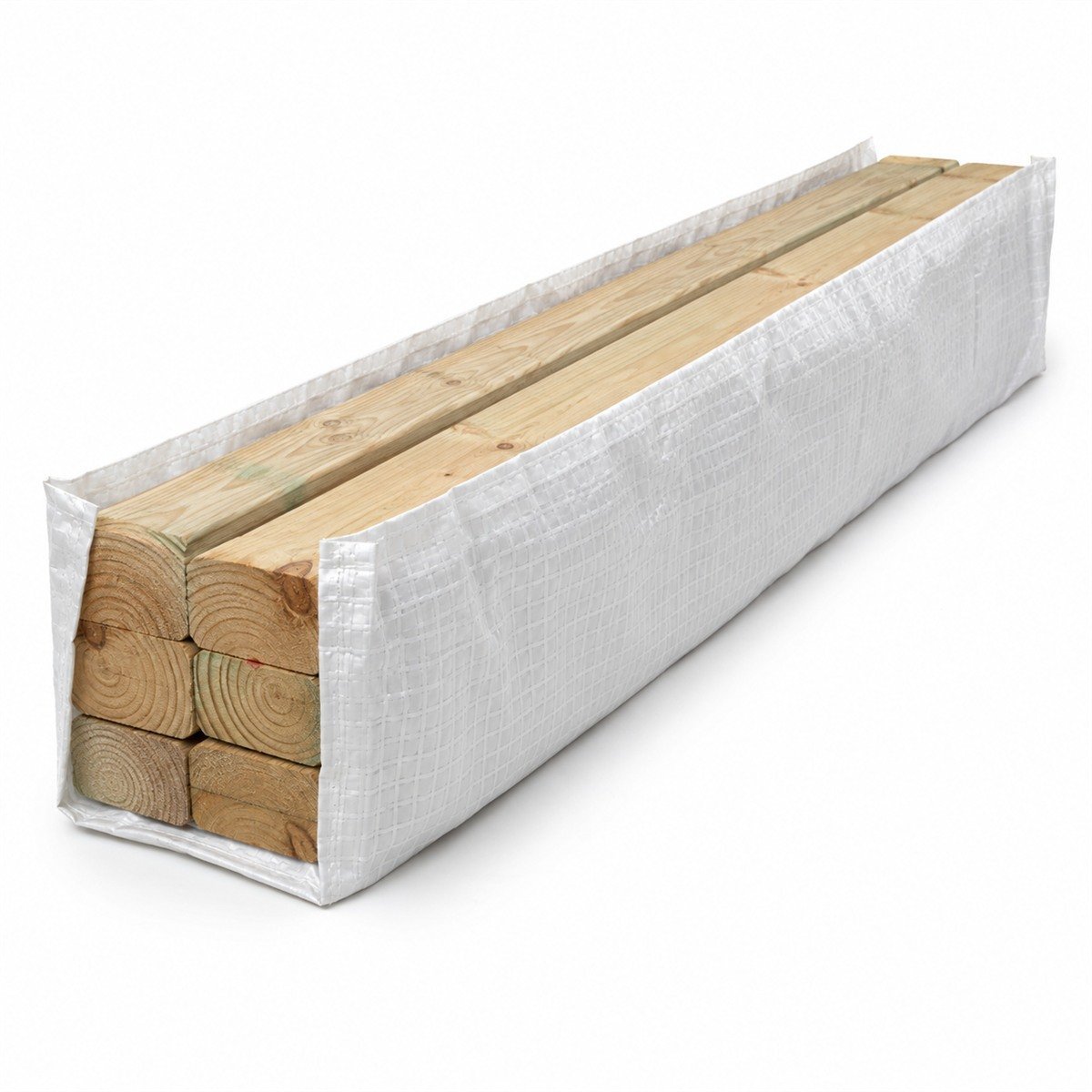
All specifications are fully customizable. Contact us to discuss your exact requirements.
| Product | Pre-made lumber bundle cover |
|---|---|
| Material | Woven polypropylene, virgin resin |
| Sizing | Width × height × length, made to your dimensions |
| Construction | Closed sewn top, open bottom, non load-bearing |
| Fabric weight | Specified to the application; heavier for abrasive or long-dwell service |
| Coating | Uncoated (breathable) or PE-coated (waterproof) |
| UV | HALS additive package compounded into the resin |
| Single-piece width | Up to approx. 224 cm (88 in); wider built as joined panels |
| Printing | Flexographic, minimum per design plus one-time plate cost |
| Colour | White standard; alternatives on request |
8 to 16 ft bundles on a fixed cross-section, typically ordered as a range of lengths against one width and height. The common case, and the one where covers beat roll stock on handling time.
Shorter, squarer bundles that do not wrap neatly from roll stock. Breathable fabric suits cedar and mulch, which keep releasing moisture in the yard.
Kiln-dried product going into a container or onto a vessel, where PE coating earns its cost and a printed cover carries identification through the chain.
More Products
Roll stock cut and wrapped on each lift — the alternative to pre-made covers for irregular bundle sizes.
Learn More →Waterproof woven PP covers and load tarps for palletised goods in outdoor staging.
Learn More →The full range of UV-stabilised woven polypropylene covers and tarps.
Learn More →A cover is pre-made to your bundle dimensions and drops over the finished bundle in one movement. Lumber wrap is roll stock that is measured, cut and wrapped on each lift. The material is the same woven polypropylene; the difference is that covers cost more per unit and save handling time, while roll stock costs less per bundle and uses more operator time. Consistent bundle sizes favour covers; irregular sizes favour roll stock.
Measure the banded bundle as it sits on the forks, not the nominal lumber size — banding, stickers and bulge all add to the real dimensions. Give width, height and length, and state clearly which dimension is which. A 52 × 28 cover and a 28 × 52 cover are different products, and getting the orientation wrong is the most common reason a spec comes back for revision.
It depends on whether the wood is still releasing moisture when you cover it. Green or freshly milled lumber wants uncoated breathable fabric, so moisture can pass out through the weave — sealing it under a coated cover traps that moisture and causes condensation, staining and mould. Kiln-dried and stable product, particularly for export or ocean freight, wants PE coating for full waterproofing.
No. A bundle cover is not load-bearing — it carries its own weight only. Any corner loops are for handling the cover itself, not for lifting the bundle. That is why fabric weight is selected for weather resistance and abrasion rather than for a safe working load, and why the construction is simpler than a lifting product such as an FIBC.
Woven polypropylene is produced on circular looms with a single-piece width of roughly 224 cm (88 in). Covers wider than that are built from joined panels, which adds a seam and a production step and can step the price up between two sizes that look similar on paper. If your cross-section sits near that boundary it is worth checking whether a small change keeps you inside single-loom width.
Yes. Flexographic printing is applied inline during manufacture and does not affect fabric performance, UV stability or breathability. Printed runs carry a production minimum per design plus a one-time plate cost, so printing suits a size you reorder regularly. Supply artwork as vector — raster files have to be redrawn before a proof can be produced.
Get a fast, no-obligation quote. We typically respond within 24 hours.