
Choosing a Lumber Wrap Supplier in Canada
Lumber wrap is usually reordered rather than sourced. Somebody specified a width and a weight years ago, and purchasing has been repeating it since. That works until it does not — and when you do go to market, the questions that separate suppliers are not the ones most buyers ask.

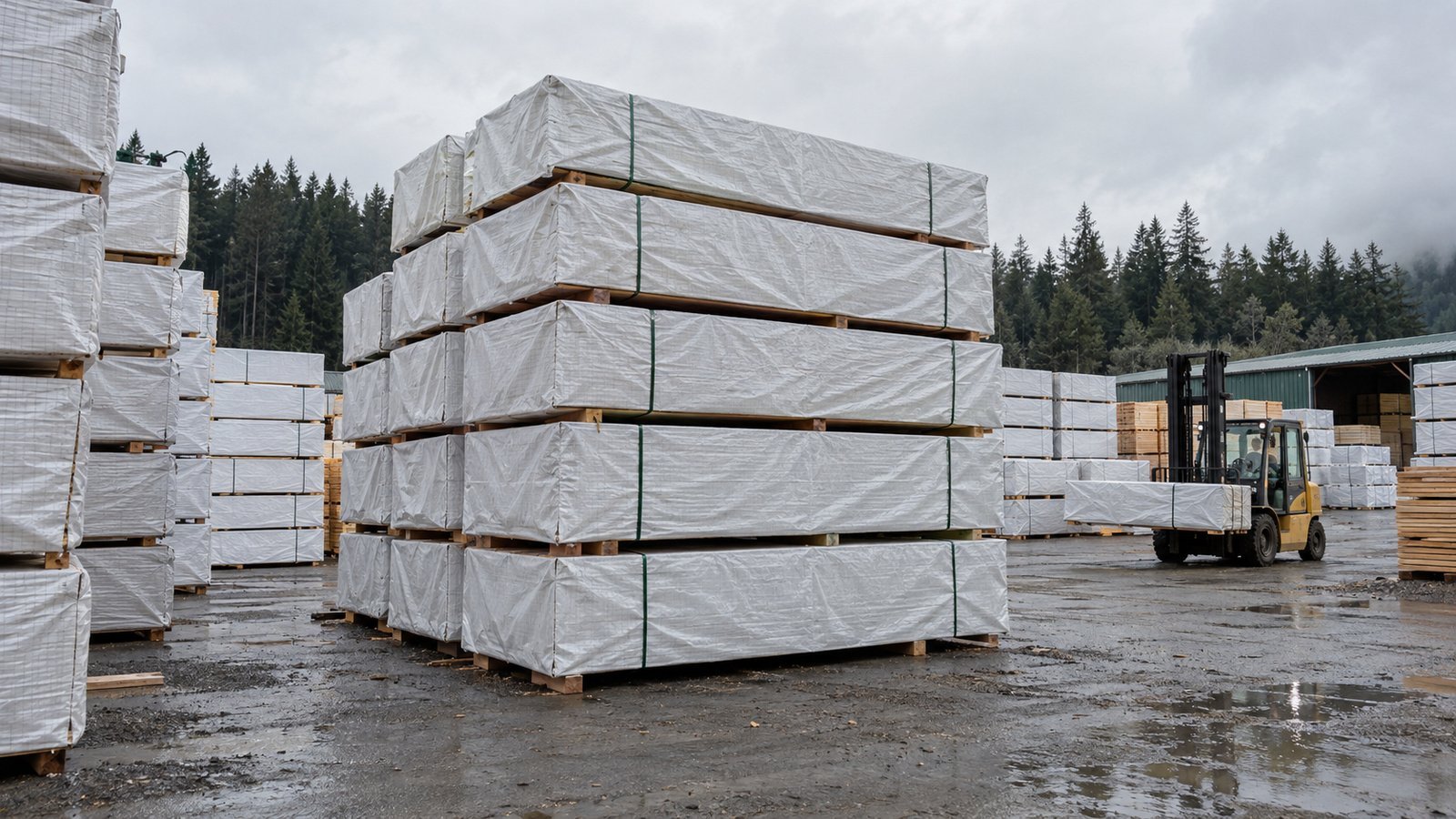
Lumber wrap is usually reordered, not sourced. Someone specified a width and a weight years ago and purchasing has repeated it since. That is fine until the supplier changes, the price moves, or a run arrives wrong and you discover nobody on site knows what the specification actually was.
When you do go to market, these are the questions that separate suppliers. Most buyers ask about price per roll, which is the least informative of them.
1. Will they give you the specification in writing?
Ask for fabric weight in GSM and the UV stabilisation package, in writing, before you order.
A supplier who answers with a grade name — "heavy", "export grade", "premium" — is describing their own internal naming, which you cannot compare against anyone else's. GSM is a measurement. It is the same number at every mill on earth.
Be equally careful in the other direction. A supplier who volunteers a very specific UV lifespan in hours is quoting a laboratory result under accelerated weathering conditions, not a guarantee for your yard. The useful thing to have is the additive package and the test standard; the hours figure depends on latitude, orientation and exposure that nobody quoting you has seen.
2. Can they match your width, and do they understand why it matters?
Width is the constraint that catches people out. Woven polypropylene is produced on circular looms, and there is a physical ceiling to the width a single loom can produce. Above that, fabric has to be seamed from multiple panels.
A seam is not automatically a problem, but it is a line of different behaviour running down your wrap, and it should be a deliberate decision rather than a surprise. If you are specifying a wide cover, ask directly whether it will be single-loom or seamed.
If a supplier does not know the answer, they are not close enough to production to be useful when something goes wrong.
3. Are you comparing landed cost per linear foot?
Roll lengths differ between suppliers. A cheaper roll that is shorter is not cheaper. Normalise everything to cost per linear foot, delivered to your yard, including freight.
| Compare | Not |
|---|---|
| Cost per linear foot, delivered | Price per roll |
| Usable width after any hem or seam | Nominal width |
| Freight to your specific site | "Freight included" with no detail |
| Price on the spec you will actually run | Price on a lighter fabric than you need |
Freight deserves particular attention in Canada. Delivery to a site in southern Ontario and delivery to one in the BC interior are not comparable costs, and a quote that buries freight tells you nothing about what you will pay.
4. What is the print capability, and what does it cost to change?
If you print, ask about colours, repeat length, and what a plate change costs. Printed runs behave differently from plain in both production and minimum quantity terms. Ask up front rather than discovering it mid-order.
5. What happens when a run is wrong?
This is the question nobody asks and everybody eventually needs answered.
Ask what the process is when fabric arrives off-spec: who inspects, what evidence they need, what the remedy is, and how long it takes. A supplier with a clear answer has had the conversation before. A supplier who is vague about it is telling you something.
Also ask who you actually talk to. The difference between a named contact who knows your spec and a general enquiries inbox shows up in exactly the week you need it to.
6. Can they supply from stock, or is everything made to order?
These are different relationships. Stock held in Canada means a shortfall can be covered quickly without a production cycle and an ocean leg. Made-to-order means you get exactly your specification but you plan further ahead.
Most operations want both: a stock product for the bulk of the volume and the ability to run custom when a job needs it. Ask which the supplier actually does, because many do only one and describe it as though they do both.
A short checklist
- Fabric weight in GSM, in writing
- UV additive package and test standard — not an hours promise
- Width capability, and whether it is single-loom or seamed
- Roll length, so you can normalise to cost per linear foot
- Freight to your site, quoted separately and explicitly
- Print capability and the cost of changing it
- The non-conformance process, in detail
- Whether stock is held in Canada
Eight questions. They take one email and they will tell you more than three rounds of price negotiation.