
Bulk Grain Bag Specification and Handling
Grain is low density, flows like a liquid, and is sensitive to both moisture and pests. Each of those pushes the specification in a different direction, and the one buyers consistently underestimate is volume — grain runs out of bag long before it runs out of weight rating.

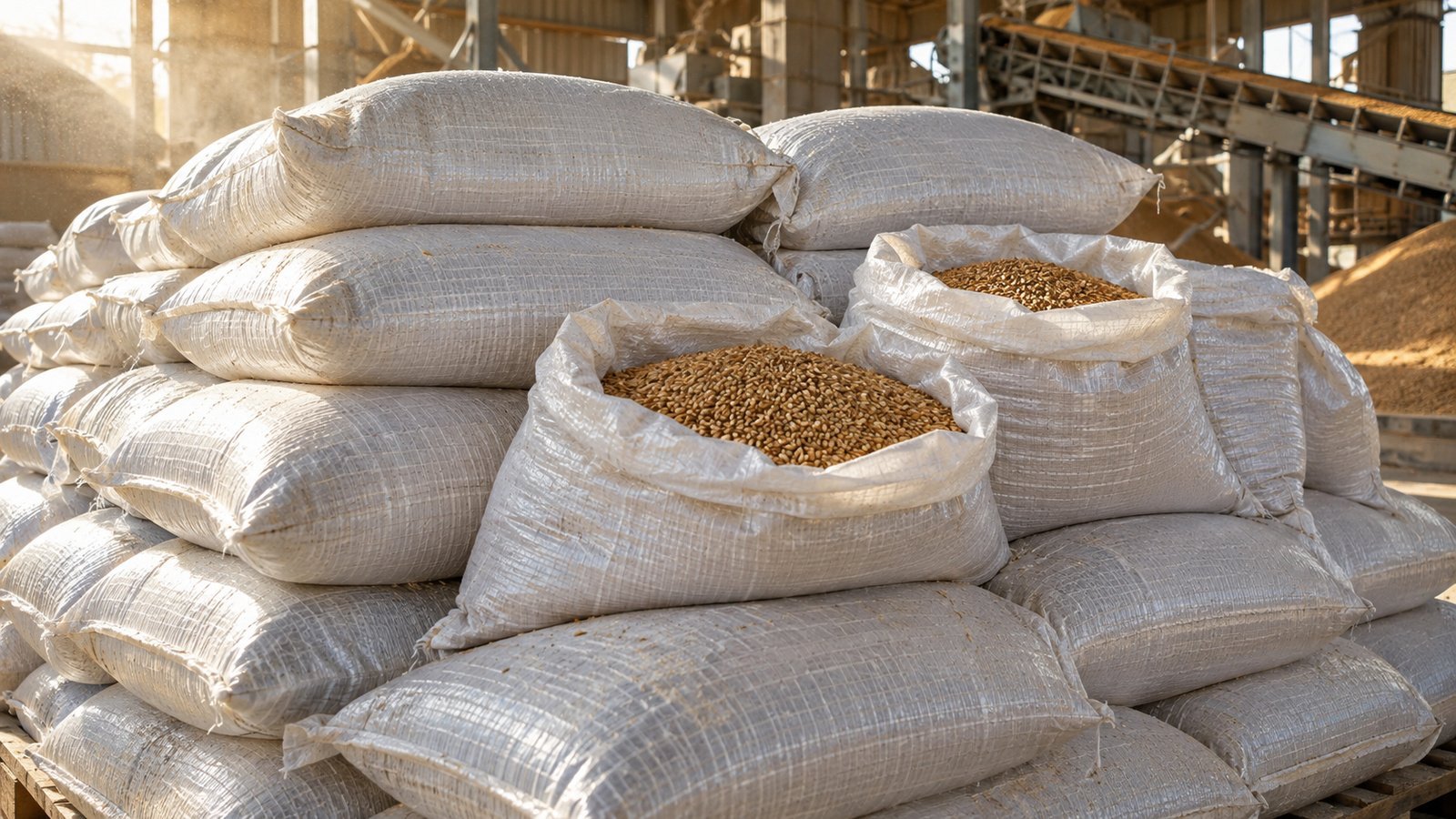
Grain looks like an easy thing to bag. It is dry, it is uniform, it is not corrosive. In practice it has three characteristics that each pull the specification a different way: it is low density, it flows freely, and it is biologically active.
Low density: volume before weight
Most cereal grains sit around 750 kg/m³. A tonne therefore occupies about 1.33 m³.
A standard 90 × 90 × 110 cm bulk bag holds roughly 0.89 m³. So a tonne of grain does not fit in a standard "one tonne" bag — not because the bag is not strong enough, but because it is not big enough.
This catches people out constantly. The rating is a weight rating; the constraint here is volume. For grain you are specifying a larger bag at the same or lower SWL, which is the opposite of the intuition most buyers bring.
| Grain | Approx. bulk density | Volume per tonne |
|---|---|---|
| Wheat | ~780 kg/m³ | 1.28 m³ |
| Barley | ~620 kg/m³ | 1.61 m³ |
| Oats | ~450 kg/m³ | 2.22 m³ |
| Corn | ~720 kg/m³ | 1.39 m³ |
Oats are the one to watch. At roughly 450 kg/m³ a tonne needs over 2 m³ — well over double a standard bag.
Free flow: seams and closure do the work
Grain behaves close to a liquid. It finds every gap, flows out of any opening, and exerts outward pressure on the bag walls that lumpy or cohesive material does not.
Practical consequences:
- Seam integrity is not optional. A seam that would hold aggregate will weep grain steadily.
- Closure method matters. A fold-and-stitch closure that is adequate for a cohesive product can leak a free-flowing one.
- Bags bulge. Outward pressure means the filled shape is rounder than you expect, which affects how many fit on a pallet and how stable the stack is.
Moisture: the decision is made at filling
Grain's condition in storage is largely determined by its moisture content when it goes in the bag. Bag grain above safe storage moisture and no packaging specification will rescue it — you have sealed in the conditions for spoilage and insect activity.
That makes the packaging question narrower and more answerable: the bag's job is to stop moisture getting in and to not create conditions that make things worse.
- Outdoor or humid storage: a moisture barrier is justified — PE lamination or a liner.
- Controlled dry storage, grain at safe moisture: plain woven is frequently correct, and a barrier adds cost without benefit.
- Grain near the top of the safe range: be careful about sealing it completely. A full barrier traps whatever moisture is present with the grain.
That last point is the one that surprises people. More barrier is not automatically better. It depends entirely on the condition of what you are putting inside.
Pests
Woven polypropylene resists insect penetration better than paper or jute, but no bag is a pest control programme. Storage hygiene, temperature management and monitoring do that work. What the bag contributes is a surface that does not itself harbour infestation and does not tear easily enough to give access.
A bag already damaged in handling is a different proposition. Torn bags in a store are an entry point, which is a reason to care about handling damage beyond the product you lose through the hole.
Stacking and pallet stability
Free-flowing fill makes bags slump, and slumped bags make unstable pallets. Two things help: filling to a geometry that stacks squarely rather than simply filling to weight, and specifying a bag whose dimensions suit your pallet pattern rather than adapting the pattern to whatever bag arrived.
What to tell a supplier
- Which grain, and its bulk density
- Target fill weight per bag
- Moisture content at filling
- Storage: indoor controlled, indoor ambient, or outdoor
- How long it will be stored
- Filling and discharge method
- Pallet pattern, if the bags have to fit an existing one
Items 1 and 3 do most of the work. Density sets the size; moisture at filling sets whether you need a barrier at all.