
PP Woven Bags for Sugar Packing
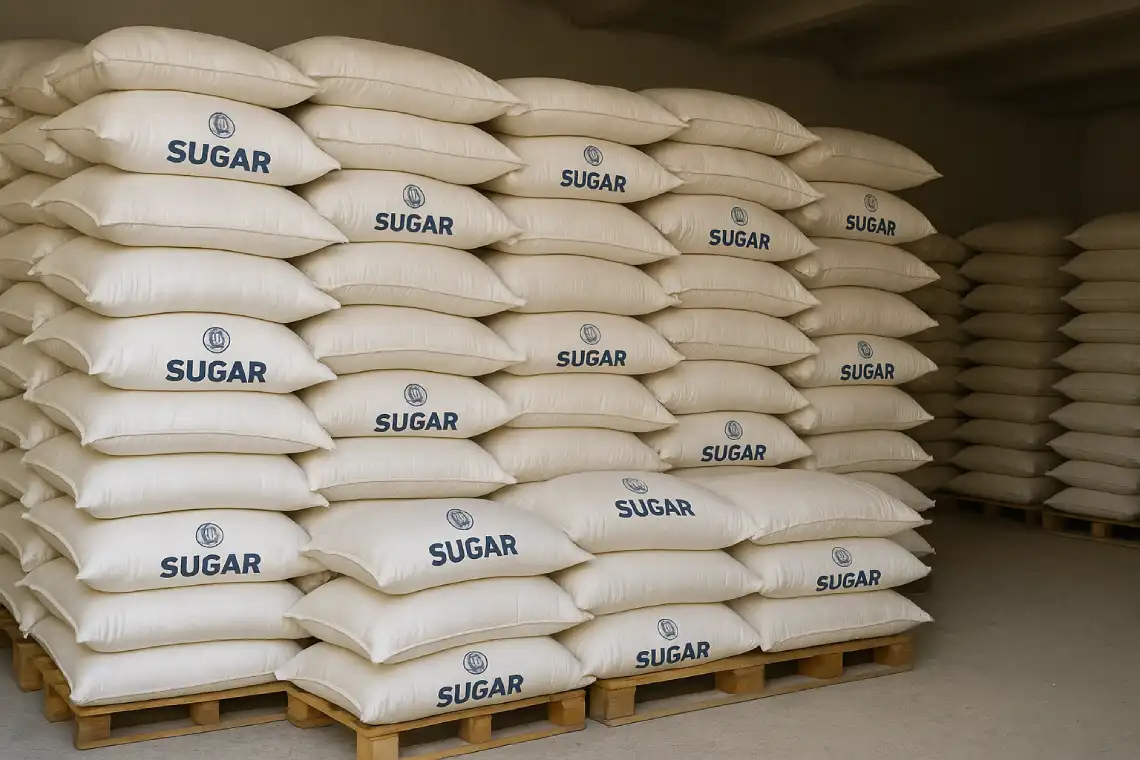
Sugar is hygroscopic. Left in contact with humid air it pulls moisture from the atmosphere, and the crystals bond into a solid block that has to be broken up before anyone can use it. Sugar also readily picks up odours from its surroundings. So a sugar bag has to work as a barrier in both directions — keeping moisture and smells out, not merely keeping product in.

Sugar is hygroscopic. Left in contact with humid air it pulls moisture from the atmosphere, and the crystals bond into a solid block that has to be broken up before anyone can use it. Sugar also readily picks up odours from its surroundings. So a sugar bag has to work as a barrier in both directions — keeping moisture and smells out, not merely keeping product in.
This guide covers specifying woven polypropylene packaging for refined and raw sugar, for Canadian packers and food manufacturers.
Caking is the failure mode to design against
Sugar cakes when surface moisture dissolves a thin film at the crystal faces and that film then re-crystallises, bonding adjacent crystals together. The result ranges from soft lumps that break under hand pressure to a block that needs mechanical breaking.
Two conditions drive it:
- Moisture ingress through the bag wall, at the seams, or at the closure
- Temperature cycling, which moves moisture around inside the bag and concentrates it wherever the pack is coolest
The second one is why sugar stored in an unheated warehouse through a Canadian winter cakes even when the bag itself is sound — every day–night cycle redistributes the moisture already inside the pack. A good barrier limits how much gets in, but temperature-stable storage is what prevents the cycling.
Once product has caked, the packaging decision has already been made badly. There is no downstream fix that is cheaper than specifying the barrier correctly.
Liner or lamination?
Both raise the moisture barrier of a woven PP bag, and they are not equivalent.
| Lamination | PE liner | |
|---|---|---|
| What it is | Film bonded to the woven fabric | A separate polyethylene bag inside the woven outer |
| Barrier quality | Good | Better, especially when heat-sealed |
| Weak point | Seams and stitch holes | Liner closure, if not sealed properly |
| Print surface | Excellent with BOPP | Unchanged — printing is on the outer |
| Best for | Shorter chains, drier storage | Long storage, humid conditions, export |
The practical rule: for product moving quickly through a controlled chain, laminated woven PP is usually enough. For long storage, humid warehousing, or ocean freight, specify a heat-sealed PE liner. Stitch holes are a real path for moisture, and a sealed liner sits inside them.
Many sugar specifications use both — laminated outer for print and handling, sealed liner for barrier.
The odour problem
Sugar picks up volatile compounds from its environment, and once it has, the product is unsellable for most end uses. This has two consequences that belong in a specification rather than in a warehouse procedure written afterwards.
First, the packaging itself must not off-gas. Inks, adhesives and any residual processing aids need to be appropriate for food contact, and a supplier should be able to speak to that specifically rather than just asserting the bag is food-grade.
Second, a sealed liner protects against warehouse neighbours. Sugar stored near cleaning chemicals, fuel, or strongly aromatic food ingredients is at risk, and the liner is the practical defence when you do not control the whole warehouse.
Food contact is three separate claims
As with FIBC, "food-grade" is the loosest term in the category. For sugar it should resolve into three answers:
- Virgin polypropylene resin — no regrind or recycled content in the food-contact layer
- An FSSC 22000 facility — or an equivalent GFSI-recognised scheme, attaching to the plant
- A documented liner — specified by material, thickness and food-contact status
In Canada, food-contact material expectations sit with Health Canada, with CFIA setting labelling requirements. If your own operation is audited, the facility scheme certificate and the liner specification are the two documents that get requested. We go into the fabric and liner side further in Polypropylene Bags for Food Packaging.
Sift-proofing and fine crystal
Refined sugar is fine enough to escape ordinary stitched seams. The consequences are the familiar ones: product loss, sticky dust on pallets, and bags that look damaged when they are structurally fine. Sticky dust is worse than inert dust — it attracts pests and it makes a warehouse unpleasant to work in.
Sift-proof construction should be named explicitly, by method — tape-over-stitch, heat sealing, or a sealed inner liner depending on the format.
Raw sugar is a different specification
Raw and unrefined sugars carry a residual molasses film and higher moisture than refined white sugar. They are stickier, more prone to clumping, and more aggressive on packaging over time.
If you handle both, resist the temptation to run one bag specification across the range. Raw sugar generally wants a heavier barrier and benefits from a sealed liner even in chains where refined product would be fine laminated.
Bulk movement
For volumes beyond bagged units, sugar moves in food-grade FIBC — one-tonne bulk bags manufactured from virgin polypropylene in FSSC 22000 facilities, with a PE liner as standard. The same moisture and odour logic applies, scaled up, and the liner becomes non-negotiable rather than optional.
Configuration detail sits at food-grade FIBC. For discharge into a hopper or dissolver, a spout-bottom configuration is usually the right choice — see spout-bottom FIBC.
What to specify
- Product — refined, raw, or specialty, with typical moisture content
- Fill weight and target dimensions
- Barrier — lamination, liner, or both, with liner thickness and closure method
- Seam construction — sift-proof, by method
- Food-contact documentation — resin, facility scheme, liner spec
- Storage and transit — duration, climate control, and whether product moves by ocean freight
- Print — colour count plus CFIA labelling requirements
Supply in Canada
Sackora supplies woven polypropylene packaging for sugar and other hygroscopic food products to Canadian packers and manufacturers, shipping from our Richmond Hill, Ontario warehouse. Laminated, lined, printed and bulk configurations are covered under PP woven bags, with application detail at sugar packaging.