
Agricultural Chemical Packaging Requirements
Packaging an agricultural chemical is not a containment problem with a regulatory footnote. The regulatory requirements shape the pack from the start — what it is made of, what goes on the outside, how it closes, and what happens to it when it is empty.

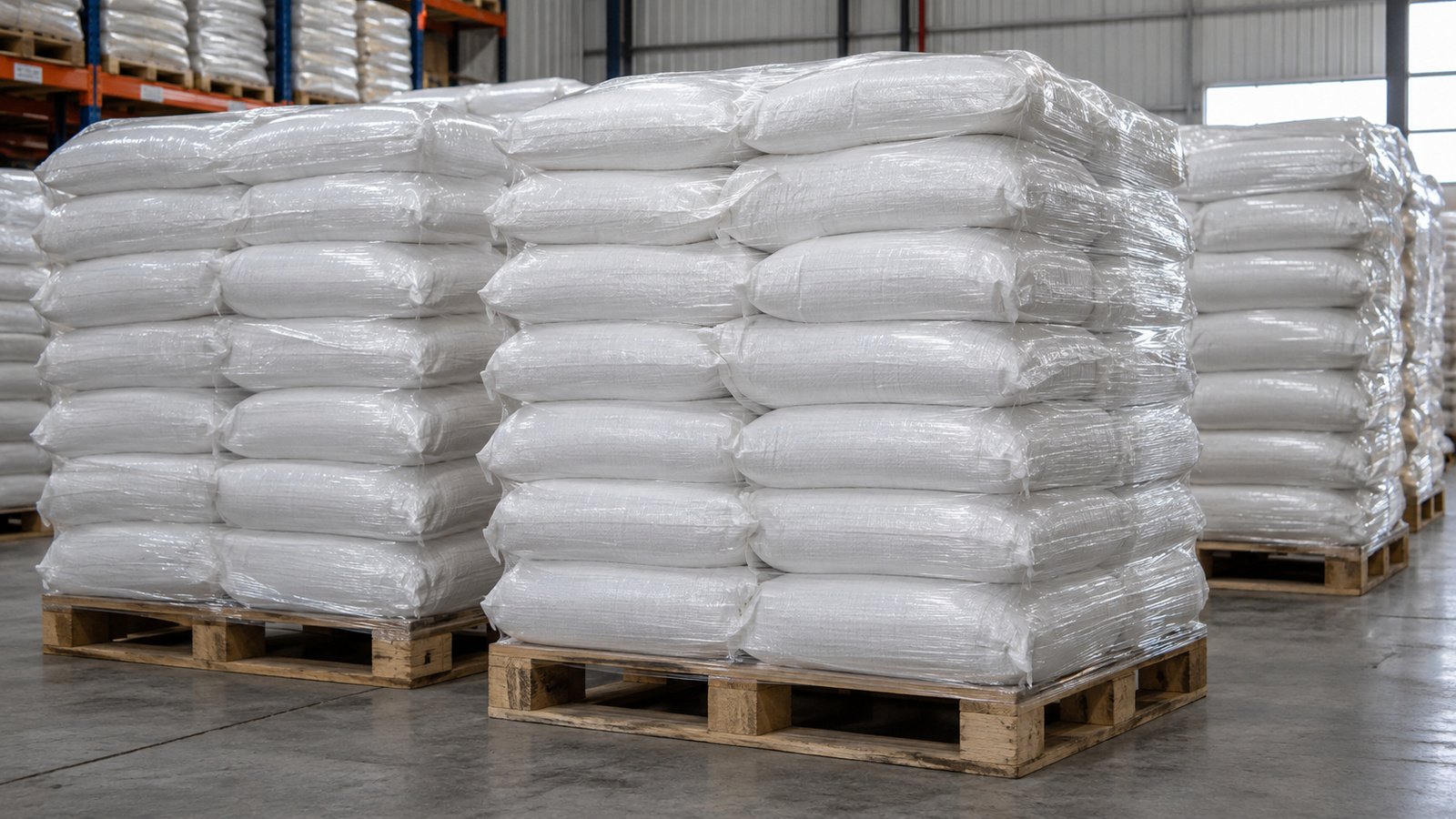
Packaging an agricultural chemical is not ordinary bagging with a compliance step bolted on at the end. The regulatory and safety requirements shape the specification from the beginning — material, barrier, closure, labelling and what happens when the pack is empty.
This is the shape of the problem for solid and granular agrochemical products in woven polypropylene.
1. Chemical compatibility comes first
Before anything else: will the product attack the pack over its shelf life?
Polypropylene is chemically resistant to a wide range of substances, which is much of why it is used here. But "resistant to most things" is not "resistant to your thing", particularly with concentrated formulations, products carrying solvent residues, or anything strongly oxidising.
Establish compatibility against the actual formulation, at the temperatures the pack will see in storage and transport, for the full shelf life. A material that holds for six months and embrittles at eighteen is a failure that surfaces in the field.
2. Moisture, because most granular agrochemicals care
Many granular agricultural chemicals are hygroscopic. They take up atmospheric moisture, cake into a solid mass, and stop flowing through application equipment. The product has not necessarily lost chemical activity — it has become unusable, which commercially amounts to the same thing.
Plain woven polypropylene is not a moisture barrier. The weave is open at the tape crossings and vapour passes through. For a hygroscopic product you need PE lamination on the inside face, a separate PE liner, or both.
Which one depends on how hygroscopic the product is and how long it sits. A liner gives a higher barrier than lamination and is the right answer for long storage or for products that must not contact the woven fabric at all. We cover the trade-off in the laminated bag spec guide.
3. Labelling has to survive distribution
Agricultural chemicals carry mandated labelling — hazard communication, registration details, directions for use, first aid. The content is determined by regulation. What packaging decides is whether it is still legible when the pack reaches the point of use.
Label integrity is a real failure mode. A pack that has been stacked, strapped, shipped and stored outdoors under a cover can arrive with print scuffed to the point of illegibility, and an unreadable hazard label is a compliance failure regardless of what was printed originally.
Options that help:
- BOPP outer lamination, which puts the print under a film layer rather than on an exposed surface
- Print placement away from the faces that take abrasion in stacking and strapping
- Avoiding fine type in positions that will be scuffed first
4. Closure and the dust question
How the bag closes determines how much product escapes as dust during filling, handling and opening. For an agricultural chemical, airborne dust is an operator exposure question, not just a housekeeping one.
Sift-proof seam construction matters here more than in most applications, and it has to be specified alongside any lamination — lamination closes the fabric but does nothing about the stitch line. Where operator exposure is a significant concern, valve construction or a liner changes the dust profile considerably.
5. Empty container disposal
This one influences material choice more than buyers expect.
Canada operates established agricultural container collection programmes, and growers increasingly expect packaging that fits into one. Material consistency helps: a pack that is predominantly a single polymer family is easier to route through a recovery stream than a multi-material composite.
Woven polypropylene with a PE liner is two polyolefins and is straightforward. Constructions mixing polymer families, foils or heavy adhesive layers are harder. If your customers participate in a collection programme, ask what their programme accepts before finalising the construction — it is a question best asked early.
6. Handling and stacking
Agrochemical packs are palletised, stretch-wrapped, stored and moved repeatedly. Fabric weight has to suit the fill weight and the stacking height, and the bag shape has to palletise squarely — a pack that slumps destabilises a pallet, and an unstable pallet of agricultural chemical is a problem of a different order from an unstable pallet of gravel.
A specification checklist
- Chemical compatibility confirmed against the actual formulation and shelf life
- Moisture barrier appropriate to how hygroscopic the product is
- Seam construction specified for dust control, alongside any lamination
- Label durability through the real distribution route
- Construction compatible with the container collection programme your customers use
- Fabric weight and bag geometry suited to fill weight and stacking
Send us the formulation type, fill weight, shelf life and distribution route and we will specify against them rather than against a generic agrochemical template.