
Recyclability of Woven Polypropylene
Polypropylene resin code 5 is recyclable in theory and in practice. The gap between the two is everything procurement teams should care about — and Canadian EPR rules are about to widen it.

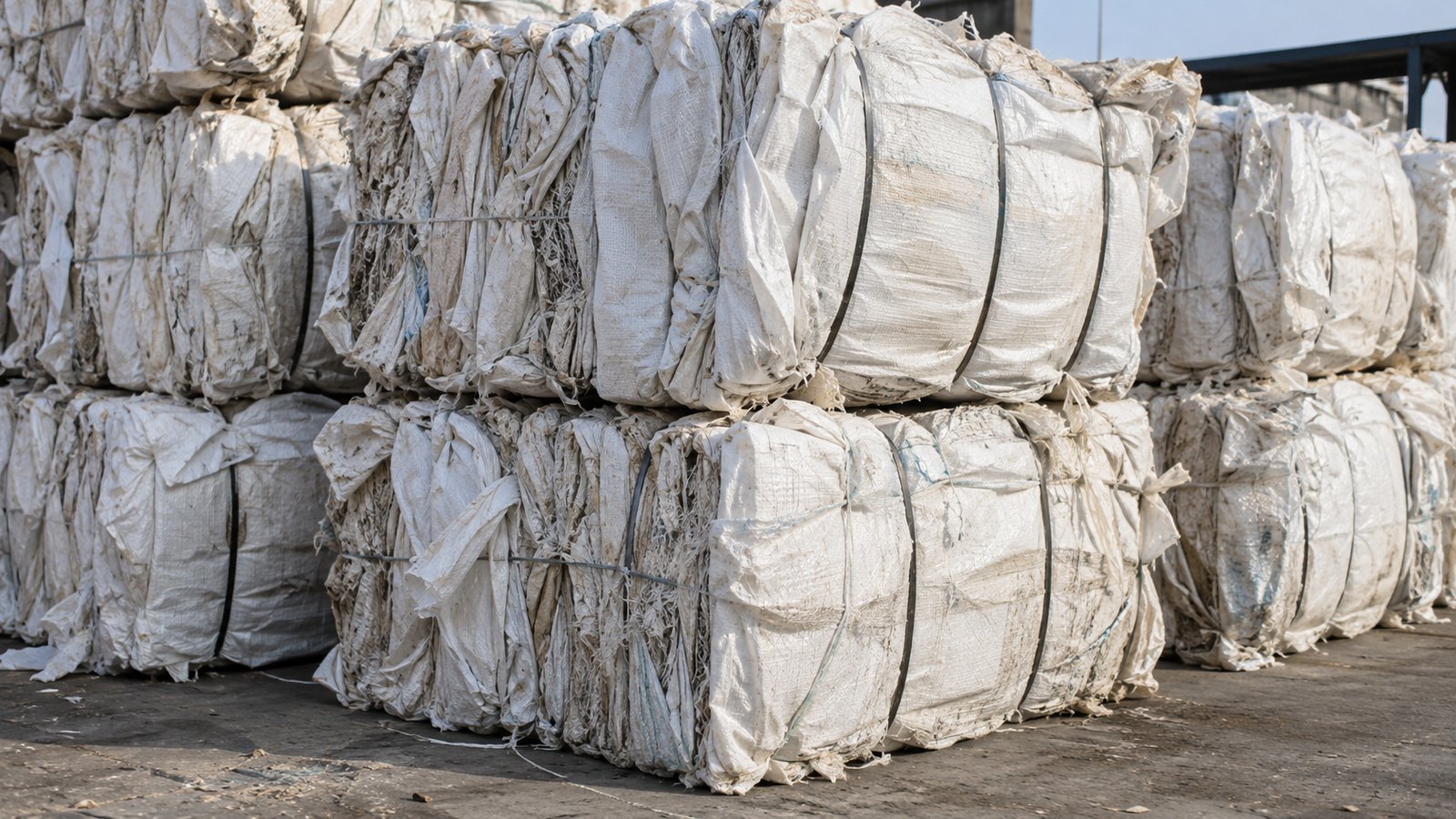
Woven polypropylene bags carry resin identification code 5 — the same code that makes yogurt cups and prescription bottles recyclable. In theory, every FIBC bulk bag, every lumber wrap roll, and every 25 kg sugar sack we supply ends its life feeding back into the polymer stream. In practice, the recycling rate for industrial PP packaging in Canada sits well below the rate for retail PP. The gap is where procurement specs matter.
Why woven PP is recyclable in the first place
Polypropylene is a thermoplastic — it melts cleanly, recrystallizes, and can be re-extruded into new film, fiber, or moulded parts. Mechanical recycling of clean PP retains 80–90% of original tensile strength through 4–5 reprocessing cycles. That's why beverage caps, automotive interior parts, and industrial textiles routinely contain recycled PP content.
Woven PP bags are uniquely well-positioned in this stream because:
- The fabric is single-polymer construction (in most cases) — no laminate separation needed
- UV stabilizers and standard processing additives don't compromise recyclability
- The bag-to-flake processing pipeline is well-established at industrial recyclers across Canada
- End markets exist for flake and pellet — agricultural twines, geotextiles, automotive parts, new woven products
What hurts recyclability (and how procurement specs cause it)
Three procurement decisions can quietly turn a recyclable bag into landfill-bound waste:
- Lamination. A PE film laminated to the woven PP outer creates a multi-material composite. Mechanical recyclers either reject these bags outright or downgrade them to lower-grade flake markets. If the moisture barrier matters more than recyclability, lamination is the right choice — but understand the trade-off. We supply both laminated and non-laminated configurations on every PP woven bag line.
- PE liners. A loose-fit PE liner inside an FIBC is separable at end-of-life — operators can remove and dispose separately. A heat-sealed or bonded liner is not separable and contaminates the recycling stream. Spec loose liners when end-of-life matters.
- Heavy printed inks. Up to 4-colour flexographic printing is recycling-tolerant. 6-colour high-coverage prints with metallic or fluorescent inks reduce flake quality and limit downstream applications. If your branded bag is destined for retail consumer disposal, the print spec affects what that bag becomes next.
Canadian EPR is about to make this expensive
Provincial Extended Producer Responsibility programs are reshaping the cost calculus for industrial packaging:
- Ontario: Full producer-responsibility for B2B packaging is scheduled for 2026, with non-recyclable packaging fees roughly 2.5× the recyclable equivalent.
- Quebec: Recyc-Québec's modulated fee schedule already penalizes non-recyclable packaging components.
- British Columbia: Recycle BC industrial stewardship fees include penalties for multi-material composite packaging.
For high-volume buyers (10,000+ bags annually), the EPR fee differential between recyclable and non-recyclable specs can exceed 5–8% of total packaging cost by 2027. That's a real procurement-line item, not a sustainability talking point.
What buyers should ask for
If recyclability is a priority for your operation, push your packaging supplier to provide:
- Material composition disclosure — single-polymer vs laminated, liner spec, ink coverage
- Resin identification code 5 marking on the bag (not just the documentation)
- End-of-life guidance per provincial EPR program
- Take-back or recycling-partner referrals where the buyer doesn't have an established stream
The bag spec drives the recycling outcome. Decide what end-of-life looks like before you sign the PO, not after.