
Laminated Bag Specification Guide for Buyers
PE and BOPP lamination get discussed as if they were competing options. They are not — they sit on opposite faces of the fabric and solve opposite problems, and confusing them is why buyers end up paying for barrier they do not need or print quality they cannot use.

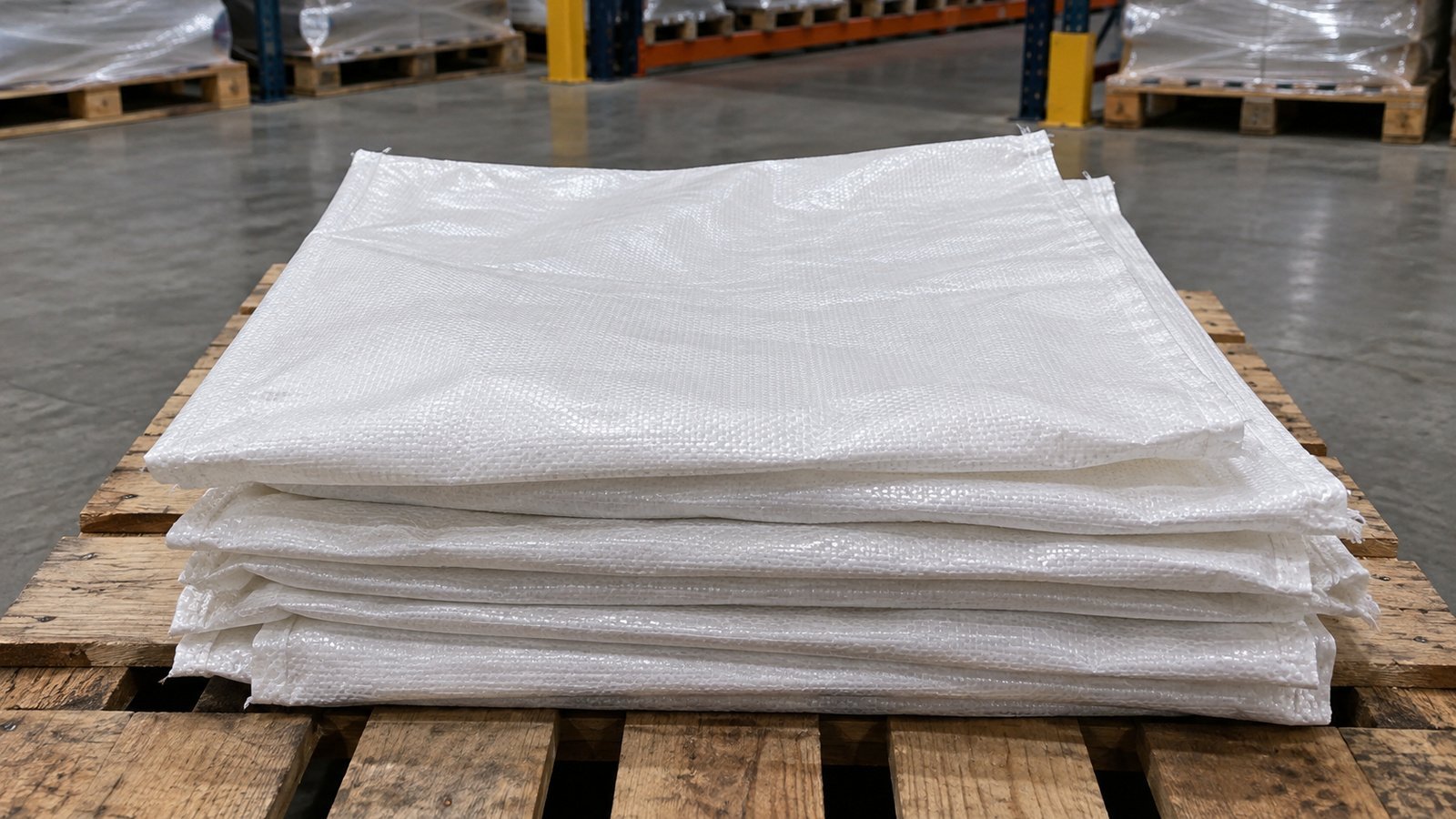
Plain woven polypropylene is strong but it is not a barrier. It is flat tapes woven over and under each other, and between those tapes are gaps. Moisture vapour goes through them, fine powder sifts out of them, and in a humid warehouse the product inside is effectively exposed to ambient conditions.
Lamination closes the gaps. Which lamination, on which face, is the decision — and it is routinely got wrong.
PE inner and BOPP outer are not alternatives
| PE inner | BOPP outer | |
|---|---|---|
| Face | Inside, against the product | Outside, facing the world |
| Job | Moisture barrier, sift-proofing | Print surface, gloss, scuff resistance |
| Typical | 15–40 micron extruded PE | 18–25 micron BOPP film |
| Does nothing for | Appearance | Moisture — wrong side of the fabric |
A specification calling for both is a double-laminated bag: barrier inside, print outside. That is a legitimate and common requirement, and it costs more than either alone. What you should not do is specify BOPP because you were told it was "better" and then wonder why the product caked.
Deciding in four questions
- Does the product take up moisture from air, or cake? PE inner, or a liner. Cement, sugar, flour, fertilizer, many resins, most powdered chemicals.
- Is it fine enough to sift through a weave? PE inner — and look hard at the seam spec too.
- Will a customer see the bag? BOPP outer, for print and scuff resistance.
- Is it bulk industrial going straight into a process? Plain woven is often correct, and lamination is money spent on nothing.
That last one is worth dwelling on. A meaningful share of laminated bags sold did not need to be laminated. If nobody can articulate what the laminate is protecting against, the honest answer may be that you are over-specified.
Reading barrier figures
Barrier is quoted as MVTR — moisture vapour transmission rate — in grams per square metre per 24 hours. Lower is better. The number is meaningless without the test conditions, so always ask for both.
A PE-laminated woven PP bag typically sits below 5 g/m²/24h at 38 °C and 90 % RH. Plain woven has no meaningful MVTR at all, because air moves through the weave freely.
If a supplier quotes an MVTR without conditions, ask. A figure at 23 °C and 50 % RH is a different and much easier test than one at 38 °C and 90 % RH, and the two are not comparable.
When a liner beats a laminate
A separate PE liner inside the sack gives a higher barrier than lamination. Specify one when:
- You need more barrier than a laminate provides
- The product must not contact the woven fabric at all
- The product is highly hygroscopic and will be stored a long time
- You want to specify food-grade contact independently of the outer bag
That last point simplifies some audits considerably — the contact surface is a documented liner rather than the bag construction as a whole.
Lamination does not seal the seams
This catches people out. Lamination closes the fabric; it does nothing about the stitching. A laminated bag with ordinary seams can still leak fine powder along the stitch line, and the complaint that follows is usually directed at the laminate.
If you are packing something fine, specify seam construction alongside lamination. The two have to be solved together or neither works.
What to put in an enquiry
| Specify | Why it changes the answer |
|---|---|
| Product and fill weight | Drives fabric weight, dimensions, and whether lamination is needed at all |
| Bag dimensions | Or fill weight plus bulk density and we work it back |
| Lamination | PE inner, BOPP outer, both, or none |
| Liner | Changes the barrier conversation entirely |
| Number of colours; drives the outer laminate choice | |
| Filling method | Hand, open-mouth automatic, or valve — determines top construction |
Enquiries with all six usually get a usable quote first time. Enquiries with two of them generate three rounds of questions.