Type C conductive and UN-rated bulk bags for copper oxide, copper concentrate, and dense mineral powders — sized to weigh out correctly and specified for the atmosphere you fill in.
Copper oxide is a dense, abrasive, electrostatically active powder. Two questions decide its bulk bag before size or price ever come up: is the filling atmosphere flammable, which sets the FIBC static type, and is the material classified as dangerous goods, which decides whether the bag must be UN-rated. Get those two right and the rest is straightforward.
An FIBC bulk bag is a flexible intermediate bulk container woven from polypropylene, rated to carry between 500 and 2,000 kg of dry bulk material. For mineral concentrates the standard 1,000 kg class applies, but the dimensions that suit a light material are wrong for a heavy one.
This is the most common and most expensive specification error in mineral packaging. Copper oxide and copper concentrate commonly fall in the region of 1,600–2,000 kg/m³ depending on particle size, moisture and how the material settles — several times the density of grain or plastic pellets.
Run that against real bag volumes and the problem is immediate:
| Bag size | Usable volume | Fill at 1,600 kg/m³ | Fill at 2,000 kg/m³ | Against a 1,000 kg SWL |
|---|---|---|---|---|
| 35 × 35 × 42 in | 843 L | ~1,349 kg | ~1,686 kg | Over the rating at roughly 60% full |
| 33 × 30 × 27 in | 438 L | ~701 kg | ~876 kg | Fills close to the rating — correct |
Densities vary by deposit and processing route, so treat these as illustrative rather than design figures for your own material. The pattern holds regardless: a general-purpose 843 L bag filled with copper oxide is over its safe working load while it still looks half empty. Operators who specify by habit rather than by density end up either overloading bags or paying for fabric they never fill.
The correct move is a smaller, squatter bag — not a stronger one. Send us your material's bulk density and target fill weight and the dimensions follow from it.
FIBC electrostatic classification is governed by IEC 61340-4-4. The four types are not quality grades. They are four different answers to what is around the bag while it is filled and discharged.
| Type | How it works | Grounding | Use when |
|---|---|---|---|
| Type A | Plain woven PP, no static protection | None | Non-flammable material, non-flammable atmosphere |
| Type B | Low breakdown-voltage fabric that prevents propagating brush discharges | None | Dry flammable powders, but no flammable gas or vapour present |
| Type C | Conductive tapes interwoven through the fabric, bonded to grounding tabs | Mandatory — must be earthed for fill and discharge | Flammable powders and flammable atmospheres |
| Type D | Static-dissipative fabric that dissipates charge without a ground path | None | Flammable powders and atmospheres where grounding cannot be guaranteed |
For copper oxide handled in a flammable atmosphere, that narrows to Type C or Type D. The deciding factor is operational rather than technical: Type C is only safe if it is actually grounded every time. If your filling station has a reliable earth point and a procedure that is followed, Type C is the established choice. If bags are handled where grounding may be skipped, Type D removes the human step at higher fabric cost.
Our conductive configuration is covered at Type C and Type D conductive FIBC.
Static type and dangerous-goods rating are separate questions, and a bag can need both. If your copper compound is classified for transport, an ISO 21898 test report is not sufficient on its own — the packaging must be a UN-certified design type, marked accordingly, and matched to the packing group. In Canada this sits under the Transportation of Dangerous Goods framework.
The practical point for procurement: UN-rated is not an upgrade of a standard bag. It is a separately tested and marked product, produced to its own specification, and it is quoted that way. Specify your UN number and packing group at enquiry rather than after the first sample. What ships with each order is set out at UN packaging documentation.
Mineral powders are abrasive in a way that agricultural material is not. Two consequences worth designing for: fabric weight at the discharge spout, where material moves fastest against the weave, and the closure itself. A star closure with a double tie holds fine powder better than a simple tie, and a discharge spout sized to your hopper avoids the bridging that leads operators to cut bags open — which defeats both the static control and any reuse.
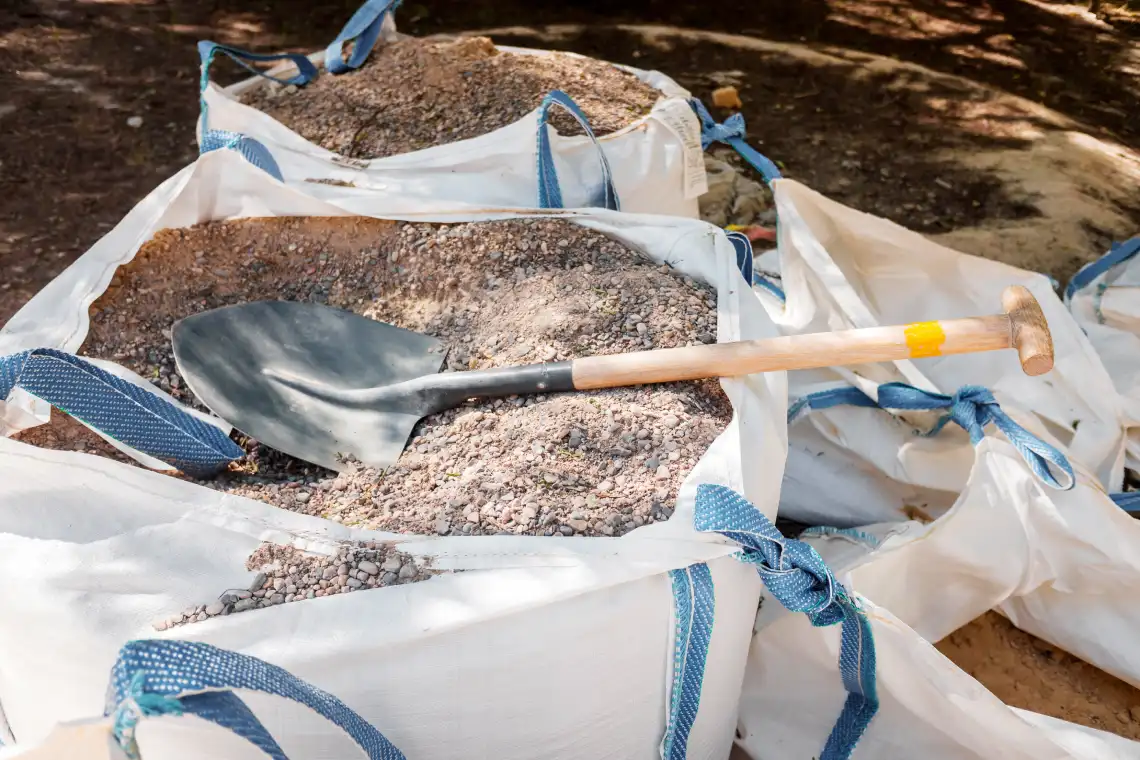
All specifications are fully customizable. Contact us to discuss your exact requirements.
| Material | Woven polypropylene, virgin resin |
|---|---|
| Fabric Weight | 170 GSM (heavier available for abrasive service) |
| Static Classification | Type A, Type C or Type D to IEC 61340-4-4 |
| Safe Working Load | 1,000 kg standard; 1,500 and 2,000 kg on request |
| Safety Factor | 5:1 single trip, 6:1 multi-trip |
| Construction | U-panel or 4-panel; 4 cross-corner lifting loops |
| Fill | Duffle top or fill spout |
| Discharge | Discharge spout with star closure, or flat sealed bottom |
| Dangerous Goods | UN-certified design types available |
| Test Standard | ISO 21898 (test report supplied) |
Recommended Products
It depends on the atmosphere you fill in, not on the copper oxide itself. In a non-flammable atmosphere with non-flammable material, Type A is sufficient. Where a flammable atmosphere is present, you need Type C (conductive, and grounded every time it is filled or discharged) or Type D (static-dissipative, no grounding required). FIBC static classification is governed by IEC 61340-4-4. If your material is also classified as dangerous goods, the bag additionally needs to be a UN-certified design type.
Type C bags have conductive tapes woven through the fabric and must be connected to earth during filling and discharge — if that connection is missed, the bag offers no static protection. Type D uses static-dissipative fabric that dissipates charge without a ground path, so there is no operator step to forget. Type C is the established choice where a reliable earth point and procedure exist; Type D costs more in fabric but removes the human variable.
Because the rating is a weight, not a volume. Copper oxide and copper concentrate commonly sit around 1,600–2,000 kg/m³, so a 843 L bag reaches 1,000 kg at roughly 60% full and keeps going if the operator fills by eye. The answer is a smaller bag matched to your material's bulk density, not a stronger one. Send us the density and target fill weight and we will size it.
Yes. UN-certified FIBCs are tested and marked to the dangerous-goods regime rather than to ISO 21898 alone, and are matched to your UN number and packing group. Because they are a separately tested design type rather than a variation of a standard bag, they are quoted separately and need the classification confirmed at enquiry stage.
170 GSM is our standard for mineral service, with heavier fabric available where material is particularly abrasive or bags see repeated handling. The discharge spout matters as much as the body — that is where material moves fastest against the weave — so reinforcement there is usually a better investment than raising the fabric weight across the whole bag.
Get a fast, no-obligation quote. We typically respond within 24 hours.